

BESS factory acceptance testing should provide traceable evidence that the agreed equipment and functions have been checked before shipment—not just a report marked “pass.” Buyers should agree on the test object, method and acceptance criteria, then review the results and any unresolved issues. Passing factory tests does not replace site commissioning, project approvals or final acceptance.
This guide follows the procurement process: define the scope, agree on witnessing and records, resolve nonconformities, and prepare the shipment decision and site handover. The tables organise evidence; they are not electrical test procedures.
Table of Contents
Define What BESS Factory Acceptance Testing Covers
The contract should identify whether testing covers a battery cabinet, PCS, controls or an integrated equipment package. Separately tested components do not automatically prove that the delivered system has been verified as a whole. Any substitute equipment or simulated interface should be identified in the scope and results.
DNV’s ATEPS energy storage verification case lists factory acceptance testing methodology under manufacturing and site acceptance testing methodology under installation and commissioning. This example illustrates why factory and site evidence should be defined separately. The test scope and acceptance criteria still need to be agreed for each project.
The terminology should also be defined clearly. In this article, FAT means Factory Acceptance Testing. Some technical documents also use FAT for Functional Acceptance Testing. Procurement documents should spell out the full term and project stage rather than relying on an acronym to assign responsibility.
Agree on the Test Plan Before Booking the Date
Ask the supplier for a plan revision, equipment list, proposed tests, applicable conditions and a sample record for engineering review. The documents should identify who performs, witnesses and reviews the work, and who has authority to approve shipment. Use the BESS procurement documents guide to prepare the wider project information.
For example, an energy capacity test requires more than a requirement to “meet nameplate capacity.” The parties should agree whether measurement is at the battery DC side or the system AC side, what conditions and tolerances apply, and how auxiliary consumption is treated. This guide does not provide universal numeric thresholds; project engineers and the supplier should establish those conditions.
If the factory cannot verify a project function, the plan should note that limitation and the later site verification arrangement, rather than silently omitting it from the report. Qualified personnel should use approved safety procedures. Buyers should not operate energised equipment or trigger protection faults themselves.
| Plan item | What to define | Evidence to retain |
| Test object | Models, serial numbers, configuration revisions | Equipment register and matching photos |
| Measurement boundary | Location, conditions and instruments | Method and measurement records |
| Functions | Actual and simulated interfaces | Results and limitations |
| Acceptance criteria | Agreed criteria and tolerances | Item-by-item assessment and review |
Turn the Test Demonstration into Reviewable Evidence
The buyer should be able to connect the report to the equipment being supplied. Request serial numbers, software or firmware revisions, test dates, instrument identification and operator details. If the demonstration uses a different sample unit, say so explicitly. A sample-unit video is not a unit-specific acceptance record for the order.
Remote witnessing can be an agreed participation method, provided that identification, live observation, raw-data delivery and interruption handling are defined. Video is only part of the evidence. Seeing “pass” on a screen does not establish that the conditions, measurement boundaries and record completeness have been verified.
The table below illustrates record design. It is not a claim that Solaura has already performed the relevant tests, nor is it a standard procedure for every device. The approved project plan determines the applicable functions and methods.
| Record type | Example evidence | Review question |
| Power and energy | Raw data and stated conditions | Does the measurement boundary match the contract? |
| Communication and controls | Command, status and response logs | Were real devices or simulated interfaces used? |
| Alarm functions | Alarm records from approved methods | Are limitations recorded? |
| Equipment identity | Register, photos and revisions | Does the record identify the shipment equipment? |
Resolve Nonconformities Before Closing the Record
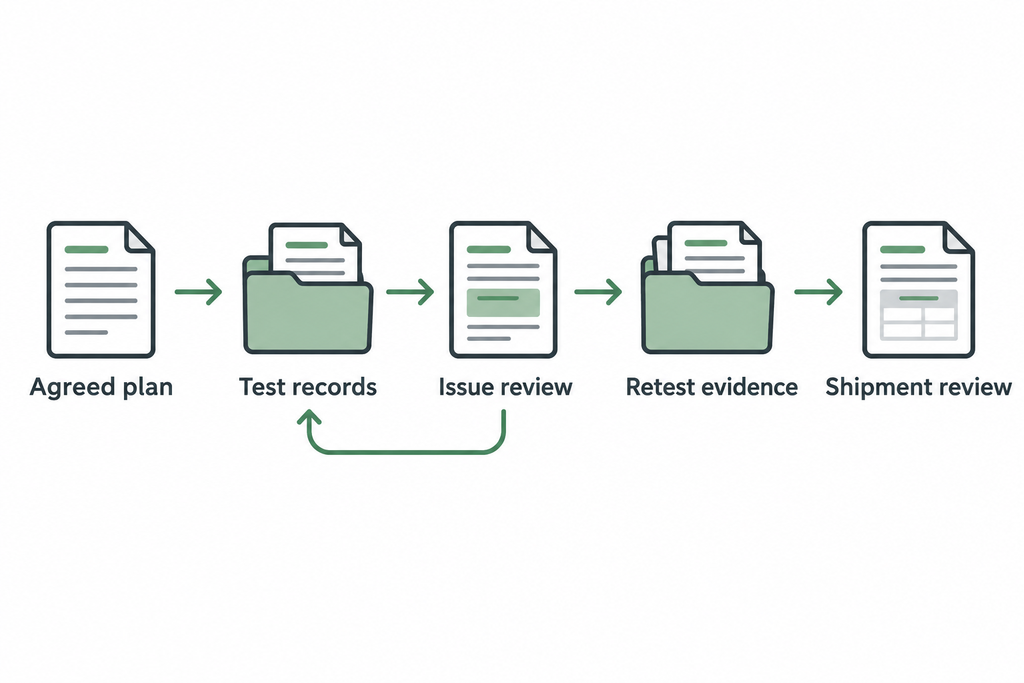
Give each nonconformity an identifier and record the original requirement, observed result, impact, owner and correction deadline. Attach retest evidence after the correction, then have an authorised reviewer close the item. Do not simply change “fail” to “pass” and delete the history.
Suppose a report shows that a control command did not receive the expected response, and the supplier then changes the configuration. The buyer needs the change record and the relevant retest results, not just an email saying the issue has been fixed. This is a process illustration, not a real project case study.
Safety-related or contract-critical issues should not be waived simply to meet a shipping date. Whether other open items permit conditional shipment requires a documented decision by the authorised project team, based on the contract and engineering review, with follow-up responsibilities defined. An article cannot make that decision for the project.
Separate Shipment Release from Site Acceptance
The shipment review package can include the approved plan, signed results, equipment identifiers, configuration revisions, nonconformity and retest records, and items reserved for site verification. Transport documents, packing and arrival inspection have separate responsibilities. Passing a test is not a substitute for every shipment condition.
Site connections, grid or generator interfaces and actual loads may differ from factory conditions. The contract should retain the applicable arrival checks, installation verification, commissioning and acceptance arrangements. BESS factory acceptance testing is not product certification and cannot by itself establish compliance at the installation location.
Buyer Questions
Does Every System Need Exactly the Same Tests?
Do not copy another project’s list without review. Develop the plan around the configuration, functions, risks and contract, and state where unit testing, sampling or other evidence applies.
Is Remote Witnessing the Same as Third-Party Certification?
No. Witnessing describes how a test is observed. Certification has its own subject, scope and assessment requirements. Video or a factory report cannot replace the required compliance documentation.
Key Takeaway
Effective BESS factory acceptance testing connects equipment identity, agreed conditions, results and issue-closure records to support a shipment decision. Buyers need reviewable evidence, not a collection of pass marks. Site verification and final acceptance responsibilities must remain clear after the factory stage ends.
For a Solaura BESS project review, submit the target power and capacity, location, operating mode, and testing and witnessing requirements. Available tests, documents, fees and site services must be confirmed in the specific quotation. This guide is not a commitment to particular testing capabilities or certifications.
Found this helpful? Share it with your network.
👇