
BESS energy management starts with a clear answer to two questions: what should the system do when site conditions change, and what could limit that action? For a project combining lithium iron phosphate (LFP) storage with solar, grid power and diesel generation, define the operating priorities, available measurements and equipment limits before selecting control functions. A menu on a screen does not prove that a function is implemented in the quoted configuration.
This guide follows a control decision from the business objective to the inputs, permitted action and evidence of the result. It explains the roles of the EMS, BMS and PCS, then provides a control brief for supplier discussions. It is a planning guide, not an electrical operating procedure or a promise of savings or transfer speed.
Table of Contents
Start With the Priority When Objectives Conflict
A business may want to use more solar, reduce grid purchases, shorten generator operation and retain outage reserve. These objectives cannot always be met at the same time. A purchase brief should go beyond asking for automatic optimisation. It should identify the priority when objectives conflict and the constraints that must remain in place.
For example, one site may prioritise retaining backup energy even during an expensive tariff period. Another may place more value on reducing grid purchases at that time. Each needs an agreed project objective; neither can be inferred from battery chemistry, capacity or the appearance of a control screen.
Separate Energy Management From Battery Limits and Power Conversion
For a planning review, the energy management system (EMS) coordinates operation around site objectives. The battery management system (BMS) monitors battery conditions and provides operating limits and protection-related information. The power conversion system (PCS) performs bidirectional power conversion. The allocation of control functions varies with the architecture; these terms do not necessarily describe three separate boxes.
The practical question is what happens to a planned action when the battery cannot currently accept it. The Victron DVCC documentation describes charge-voltage, charge-current and discharge-current limits communicated by supported managed batteries. This is a product-specific example, not evidence that a Solaura system uses the same interfaces or control logic.
A BESS energy management brief should ask where limits originate, how they are enforced and how a constrained action is recorded. Battery and equipment protection must not be bypassed to pursue an energy-cost target.
Check Which Inputs the Controller Actually Receives
PV output, site consumption and grid import are different measurements. Battery power alone may not explain how much electricity the whole facility is importing. The SMA energy management requirements specify a suitable meter at the point of interconnection for that system. This illustrates why measurement location matters, not that every project must use the same equipment.
Ask the supplier to identify measurement locations on the project drawing and distinguish measured, calculated and forecast values. Also clarify updates, timestamps and treatment of invalid data. An outdated value can still appear as a number, so a populated screen should not be the only acceptance criterion.
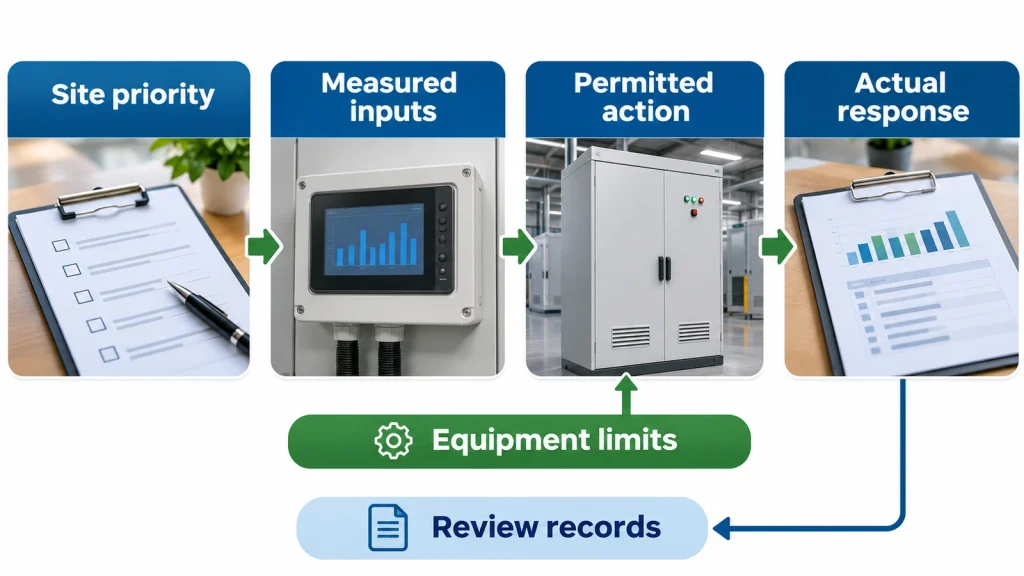
Trace One Operating Change From Input to Response
Consider an illustrative discussion scenario: factory demand rises while solar output falls and an agreed battery reserve still has to be retained. Instead of asking only whether the battery takes priority, ask how the readings affect the action, which limits change the outcome and where the remaining power would come from. This scenario assumes no particular equipment capability or fixed settings.
Where a generator is included, establish whether the controller only displays its status or can request starting, charging or coordinated operation within the approved design. Automatic starting, paralleling, island operation and seamless transfer are different capabilities. None follows simply from a statement that an EMS is supported.
Review the return of grid power as well. Resuming normal operation, recharging the battery and supplying production may coincide. The proposal should explain how available site capacity and equipment limits constrain that plan, rather than promise maximum-rate charging whenever the grid returns.
Put BESS Energy Management Into a Reviewable Control Brief
Use the table for procurement discussions, not as a list of settings to enter. Each item should relate to the quoted models, controller version and project configuration. A demonstration from another project should not be treated as a delivered capability for this one.
| Review item | What to document |
|---|---|
| Operating priority | Priority when objectives conflict and constraints to retain |
| Data inputs | Locations, sources, timestamps and invalid-data handling |
| Battery and PCS limits | Origin, enforcement and records of constrained operation |
| Source control scope | Read and control capabilities for PV, grid and generator |
| Changed conditions | Expected response to load changes, grid loss and return |
| Verification records | Requested action, actual response, simulations and open items |
Distinguish a Requested Action From the Actual Result
Where available, a review record should connect the inputs, operating mode, requested action, actual power and limiting reason for the same interval. Failure to reach a requested power level may reflect a valid constraint rather than a fault. Conversely, seeing a command does not prove that the equipment executed it.
The BESS remote monitoring guide covers history and exports; here, the question is whether those records explain a control decision. The factory acceptance testing guide can help organise the verification plan. Identify simulated signals and equipment absent from a demonstration. Site verification belongs to competent personnel working to an approved plan, not an improvised outage or protection change.
Buyer Questions
Can an EMS Replace the BMS?
They should not be procured as interchangeable functions. Site-level coordination does not remove the need for battery monitoring and protection. Review the actual configuration and its interfaces rather than comparing acronyms alone.
Does a Remote Dashboard Prove Automatic Source Coordination?
No. Displaying data and controlling equipment are different capabilities. Identify which devices are read-only, which can accept commands and which need a separate controller, then confirm the supported scope.
Key Takeaway
Useful BESS energy management turns site priorities into operating decisions that respect equipment limits and can be checked. Confirm the priority, then review the inputs, supported actions and result records. That gives a buyer a stronger basis for selection than comparing screens or feature names alone.
When discussing battery energy storage systems with Solaura, provide the site sources, load records, operating priorities and existing equipment models. Request a defined control scope and verification approach. Specific functions depend on the selected configuration and confirmed proposal.
Found this helpful? Share it with your network.
👇