
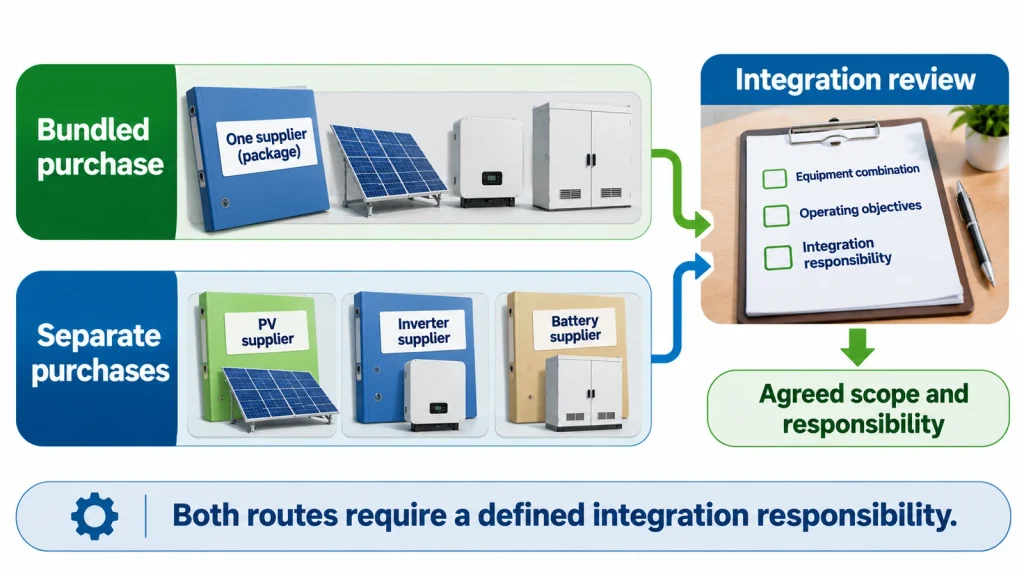
Buying solar panels, an inverter and a battery together can simplify purchasing coordination, but a package is not automatically the best fit. Separate purchases can preserve suitable existing equipment, but someone must take responsibility for integrating the combination. Choose the purchasing route around the project, not the number of suppliers or the lowest component price.
This guide helps commercial and EPC buyers choose between a coordinated equipment package and separate orders. It starts with new and existing installations, then compares supply boundaries, integration responsibilities and costs on an equal basis. A solar inverter and battery supplier should explain how the proposed package works with the PV equipment and who is responsible for integration before the buyer commits to either purchasing route.
Table of Contents
Start With New Equipment or an Existing Installation
For a new installation, the buyer can ask for PV equipment, battery storage, conversion equipment and controls within one coordinated proposal. The owner still needs to provide load information, available power sources and operating objectives. Buying a package does not mean that site design, protection requirements or installation arrangements have already been completed.
For an existing installation, list the equipment models, available commissioning records, present operating mode and proposed new functions. Do not replace a working inverter merely because it is absent from a package. Equally, do not assume that existing equipment can support a battery simply because it still operates. The existing solar storage retrofit guide covers the technical review behind that decision.
What Does the Solar Inverter and Battery Supplier Include?
Ask for an itemised package with model references and exclusions. Solar modules, an LFP battery, a PCS or inverter, controls and metering may sit within different supply boundaries. Mounting structures, cables, protection equipment and installation should not be assumed included. The word complete is useful only when the quotation explains what is complete and what remains outside it.
A single purchasing contact may make coordination easier, but it does not necessarily mean one manufacturer or one warranty. Identify who reviews the equipment combination, supports site commissioning and coordinates faults involving more than one component. A collection of individual product warranties is not, by itself, an agreement to resolve integration problems.
Assign Integration Responsibility for Separate Orders
Separate orders can make sense when a project retains suitable equipment or has a clear reason to choose components from different sources. The buyer should identify a competent integration lead before placing those orders. That role may belong to an EPC contractor, an agreed supplier or another qualified party; it should not be left for an installer to discover after delivery.
The review should use exact models, relevant versions and the intended operating mode. Matching interface names does not establish that the requested functions are supported. Ask for combination-specific electrical, communication and control information, and identify any additional equipment or changes required. Keep unresolved items visible rather than turning assumptions into purchase approvals.
The Victron battery compatibility guidance provides information for tested batteries and separate guidance for batteries outside its list. This is an example of checking a particular combination, not evidence that every unlisted battery is incompatible. It also does not establish that another supplier has been tested or approved by Victron.
Compare Prices on the Same Supply Boundary
Compare prices only after aligning the load objective, equipment scope and required functions. A component-only offer is not directly comparable with a package that includes controls or commissioning support. For separate orders, list the confirmed integration work and additional accessories alongside the equipment prices. Leave unquoted costs open instead of treating them as zero.
Delivery, transport, site work and support conditions should also use a common comparison basis. Neither purchasing route guarantees a lower total cost. Retaining equipment may avoid a replacement purchase, but only if its suitability is confirmed and the cost of adapting the arrangement is understood. The supplier assessment guide can help evaluate the replies received from each candidate.
Record Both Purchasing Routes in One Table
Use the following worksheet for each route. It is a purchasing template, not measured project data or a cost ranking. Record the supporting document and any unquoted item so that an apparently cheaper option is not accepted simply because part of its scope is missing.
| Review item | Information to confirm |
|---|---|
| Existing equipment | Retained or replaced equipment and supporting review |
| New supply | Exact models and exclusions |
| Combination review | Responsible party and applicable documents |
| Integration work | Additional accessories and work scope |
| Price comparison | Same-scope costs and unquoted items |
| Handover | Commissioning support and outstanding work |
| After-sales support | Product warranties and cross-component fault coordination |
Agree Changes and Handover Before Ordering
Agree how substitutions and version changes will be reviewed. A package should not allow an unreviewed replacement merely because it comes from the same seller. For separate orders, notify the parties whose equipment is affected. Handover records should identify what was supplied, the actual models and the agreed test records, with responsibilities for outstanding work made clear.
Buyer Questions
Does Buying From One Supplier Guarantee Compatibility?
No. Ask for written confirmation covering the proposed models, operating mode and integration scope. A single invoice is not a substitute for that review or for agreed verification responsibilities.
Must an Existing Solar Inverter Be Replaced?
Not necessarily. The decision needs the existing equipment information, proposed battery arrangement and required operating mode. Neither retention nor replacement should be promised before that assessment.
Key Takeaway
For a new project, compare coordinated supply options. For an existing installation, first establish what can reasonably remain. In either case, choose the route with a clear scope, supported equipment combination and assigned integration responsibilities, then compare complete offers.
When reviewing battery energy storage systems, provide the existing equipment list, load records, power-source information and purchasing preferences for assessment by the BESS manufacturer and the project integration lead.
Found this helpful? Share it with your network.
👇