

BESS round-trip efficiency is useful for comparing proposals only when its measurement boundary and operating conditions are clear. It describes energy returned through a complete charge and discharge cycle, not the usable fraction of battery capacity or a safety reserve. For lithium iron phosphate (LFP) storage, first establish whether a figure describes the battery, the converter or the complete system.
This guide follows energy through charging, storage and discharge, then explains the limits of monitoring records and provides a supplier review worksheet. The aim is to read an efficiency claim correctly, not to assign a performance value to an untested product or promise a financial return.
Table of Contents
Establish What the Percentage Describes
Battery-terminal DC efficiency and AC round-trip efficiency that includes a bidirectional converter cover different paths. A peak inverter efficiency is not the efficiency of a complete storage cycle either. Before comparing two proposals, put their measurement points and included equipment side by side. A higher percentage does not establish a better system if one figure excludes equipment that the other includes.
For a complete cycle with comparable stored energy at the start and end, round-trip efficiency can be expressed as output energy divided by input energy, multiplied by 100%. Use energy units such as kWh on both sides, not an instantaneous kW reading. Identify any externally supplied auxiliary consumption excluded from that boundary rather than silently treating it as zero.
Follow the Energy Through the System
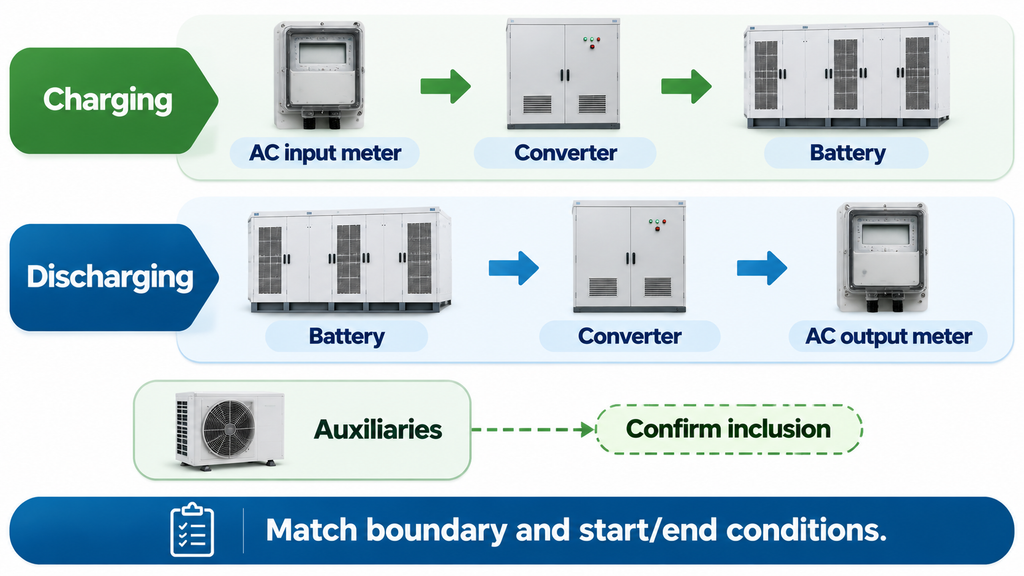
Charging may involve power conversion, energy is lost within the battery, and discharge may involve another conversion. The path depends on the system architecture. Ask the manufacturer to identify the tested path instead of assuming that solar charging and grid charging use identical boundaries. Electricity supplied directly to a load without passing through the battery should not be counted as battery discharge.
Cooling, controls and other auxiliaries may also consume electricity. Confirm where they are supplied and whether their consumption is already included in the quoted efficiency. Do not deduct the same consumption again in a later calculation. If it is excluded, record it separately for the relevant operating period. The equipment list and meter locations matter more than an unexplained allowance.
Include the Time Spent Waiting
Two systems can handle the same amount of energy while spending different amounts of time waiting and operating at different power levels. Consumption during a longer idle period can change the energy ratio over the observation period. A test result at one operating point should not be presented as the annual result for a factory with a different schedule.
The SMA technical note on storage efficiency discusses conversion losses, idle operation and the effect of different stored energy at the beginning and end of a measurement period. It concerns a particular older system, not a performance benchmark for current commercial LFP equipment. Its numerical efficiency ranges are not used here as purchasing targets.
Why a Daily Monitoring Ratio Can Mislead
A day with substantial charging may end with energy still stored for tomorrow. Dividing that day’s discharge by its charge can treat retained energy as though it were lost. Conversely, a day that releases energy stored earlier can show a misleadingly high ratio. Neither pattern establishes the efficiency of a completed cycle on its own.
Review starting and ending conditions, timestamps, meter positions, missing data and measurement accuracy. Multiplying a change in state of charge by nameplate capacity is not automatically a precise correction for stored energy. Ask the manufacturer to explain the applicable energy accounting method and provide a defined test where necessary. The BESS remote monitoring guide covers the records and export questions behind that review.
Keep Efficiency Separate From Usable Capacity
Usable capacity concerns the energy available within an agreed operating window. BESS round-trip efficiency concerns the ratio between output and input through the charge and discharge path. Any operating reserve should be stated separately. Renaming an energy-loss allowance as a reserve does not justify deducting it twice. The LFP usable capacity guide explains the separate capacity question.
A verified efficiency applicable to the chosen boundary can help estimate replenishment energy. Estimating how long an already charged battery will support a load is a different task: it needs usable energy, the discharge path and load records. Do not substitute a complete round-trip figure for a one-way discharge factor. Both calculations also need the auxiliary consumption treatment to be explicit.
Request Comparable BESS Round-Trip Efficiency Evidence
The worksheet below collects evidence; it is not a test result. The owner supplies operating schedules and site records, while the BESS manufacturer supplies model-specific parameters, test evidence and open questions. An experience-based estimate should remain labelled as an estimate, not be moved into a guaranteed-performance field.
| Review item | Evidence to request |
|---|---|
| Boundary | AC or DC meter locations and included equipment |
| Model | Battery, PCS and applicable configuration |
| Operating conditions | Power, temperature, cycle and idle periods |
| Auxiliaries | Supply location and inclusion in the figure |
| Start and end | Stored-energy comparability and accounting method |
| Record quality | Timestamps, measurement accuracy and gaps |
| Claim status | Measured, estimated or contractually guaranteed; scope |
Buyer Questions
Does the Highest Efficiency Mean the Lowest Electricity Cost?
Not necessarily. Cost also depends on tariffs, operating periods, equipment costs and the supply objective. Efficiency is an input to an assessment, not a savings conclusion. Combine it with the load and tariff evidence described in the factory storage assessment rather than selecting a system by the highest percentage alone.
Can an Estimated Loss Replace Test Evidence?
No. An estimate can inform an internal discussion, but a public performance claim needs a stated source and applicable conditions. When the measurement boundary is unknown, leave the item open and request evidence. Do not fill the gap with an assumed universal industry value.
Key Takeaway
BESS round-trip efficiency should be read alongside its boundary, auxiliary consumption, starting and ending conditions and operating profile. Establish what a figure measures before using it in a proposal assessment. Keep capacity reserves separate from energy losses and avoid double deductions. A reliable comparison needs reviewable evidence, not an isolated percentage.
For a manufacturer review, provide the site purpose, load and charging schedules, and the efficiency claim that needs checking. Request documentation for the proposed model and a preliminary assessment based on those records.
Found this helpful? Share it with your network.
👇