Adding battery storage to an existing solar system starts with actual daytime surplus, later electricity demand and the equipment already installed. Solar capacity is not the same as energy available for charging. An LFP BESS also does not automatically allow solar to keep running during an outage. Confirm the operating objective, equipment arrangement and customer tariff before selecting capacity.
This guide follows a business that already has solar through surplus generation, later-shift demand, outage needs and retrofit decisions. An official historical Zimbabwe tariff illustrates the billing questions to ask. A final worksheet brings together the information the owner should provide to a BESS manufacturer. No completed customer project or guaranteed saving is presented.
Table of Contents
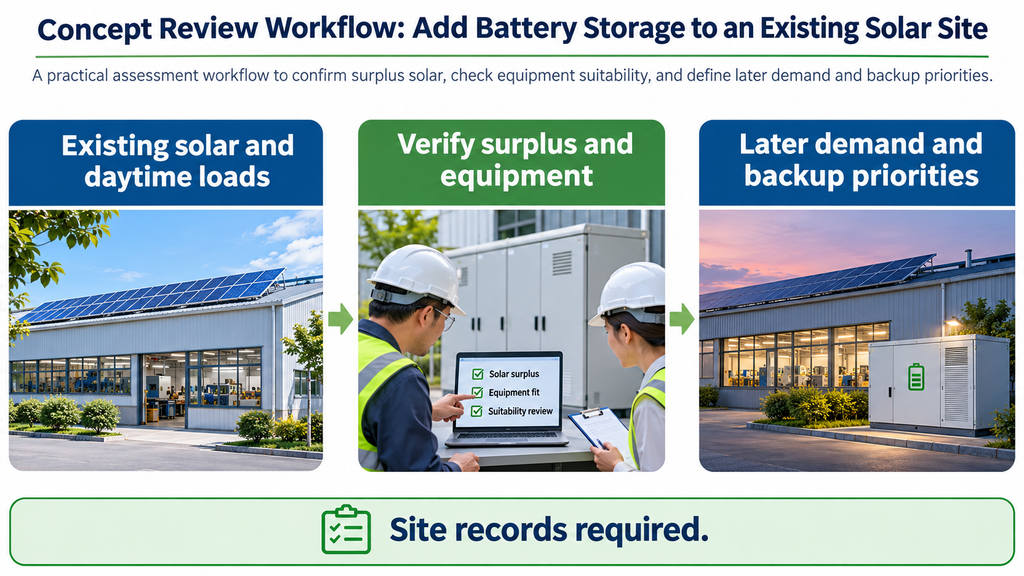
Find the Solar Energy That Is Actually Available
Match solar generation and site demand over the same intervals. Solar electricity already used by production cannot also be allocated to the battery. Distinguish exported energy, curtailed generation and missing records. Multiplying inverter rated power by daylight hours does not establish a dependable daily storage resource. Review representative production days and seasonal conditions rather than selecting the sunniest day.
If little solar surplus remains, other charging sources can still be assessed, but the proposal should not claim to capture large amounts of unused solar. Where production is flexible, compare moving consumption into solar hours with adding a battery. Keeping the existing system and changing the schedule may address part of the problem without a retrofit.
Match Stored Energy to a Later Operating Need
Identify the loads needed during a later shift, overnight and during an outage, their duration and their tolerance for interruption. Energy reserved for backup is not automatically available for routine tariff shifting. The same stored electricity cannot be committed twice. State which objective takes priority when a scheduled discharge would reduce the reserve needed for an outage.
Charging time matters as much as the requested discharge period. If solar surplus occurs within a short window, review charging power and site constraints. A larger battery is not guaranteed to refill during the available window. Adding battery storage therefore needs time-matched records, not just a monthly solar-generation total and a monthly electricity bill.
Establish What Can Stay in the Existing System
Collect inverter models, the single-line diagram, meter locations, connection conditions and existing backup-source information. Retaining an inverter requires review of the complete equipment combination, not just its brand or a grid-connected label. Competent personnel and manufacturers should confirm compatibility, protection and control scope. Do not assume a battery cabinet can simply be attached to any existing installation.
The Victron ESS system design manual distinguishes operating arrangements according to where PV is connected. It illustrates why connection position affects outage behaviour, but its product-specific rules must not be transferred to another manufacturer’s equipment. This article provides no wiring or protection-setting instructions. An approved retrofit design is separate from an initial purchasing discussion.
Treat Normal Operation and Outage Operation Separately
Functions available with the grid present are not necessarily available when it fails. Identify the loads supplied by the backup arrangement, whether solar can operate in the approved configuration and how recovery is handled after an extended outage. Having a battery is not proof of seamless backup for the whole factory. Required transfer behaviour needs equipment-specific confirmation.
Where a generator exists, establish its role before and after the retrofit. A brochure mentioning solar, grid and diesel does not confirm compatibility with every installed generator or inverter. Keep unverified combinations open for review rather than presenting them as included capabilities.
Use a Historical Zimbabwe Tariff to Frame the Questions
The ZETDC historical tariff schedule states an effective date of 1 December 2023. The table below extracts energy charges for Mining, Industrial, Commercial & Pumping Works customers under the maximum-demand category. These energy rates are the same for the listed 0.4 kV, 11 kV and 33 kV supplies. This is not a verified current tariff for 2026.
| Historical period | USD per kWh |
|---|---|
| On-peak | 0.24 |
| Standard | 0.13 |
| Off-peak | 0.08 |
The document lists prices in USD and describes conversion to ZiG at purchase using the applicable exchange rate from 6 April 2024. It separately lists demand, fixed monthly and reactive-energy charges, and excludes the levies and VAT specified in its notes. Confirm present prices, taxes and settlement arrangements against the customer’s bill and supplier confirmation.
The historical peak-to-off-peak energy-rate difference is USD 0.16/kWh, but that is not net profit for each discharged kWh. Grid charging requires allowance for purchased charging energy and losses. Solar charging needs verified surplus and consideration of alternative uses. Fixed charges do not automatically disappear when a battery is added. Demand-charge effects require the applicable billing rules and measured load profile.
The owner should provide recent bills and the current time-of-use schedule rather than using an online historical table to promise payback. The BESS round-trip efficiency guide explains the treatment of a complete charge and discharge path. Where efficiency is unverified, do not insert an experience-based percentage as a performance commitment.
Prepare the Existing Site for Adding Battery Storage
The owner should supply or arrange the evidence below for preliminary review by a BESS manufacturer. The manufacturer still needs to identify the proposed models, compatibility conditions and unresolved design items. This worksheet is not a completed retrofit design and contains no assumed capacity or investment return.
| Evidence | Owner input and verification |
|---|---|
| Existing equipment | Inverters, diagram and backup sources; compatibility to verify |
| Generation and demand | Matched records, surplus, export and data gaps |
| Current billing | Bills, category, periods, demand rules and taxes |
| Operating objective | Later shift, backup loads and interruption limits |
| Site changes | Equipment location, access and shutdown planning |
Buyer Questions
Must the Existing Solar Inverter Be Replaced?
Not necessarily, but retention is not guaranteed. Review the exact model, topology, controls, protection and required outage functions before deciding what can remain. A model list and an existing single-line diagram are useful starting points, not final compatibility approval.
Does a Tariff Difference Justify the Purchase?
Not by itself. The assessment also needs loads, charging windows, losses, costs and backup requirements. The factory storage assessment guide helps organise those conditions. The appropriate result may be further measurement or no retrofit yet, not an immediate equipment order.
Key Takeaway
Adding battery storage should start with actual solar surplus and later demand, followed by the existing equipment, outage functions and real billing conditions. An official historical tariff helps frame the questions; it does not replace the customer’s current bill or establish savings. Choose an LFP storage configuration only after those inputs support the decision.
For a preliminary proposal, provide a BESS manufacturer with inverter models, the single-line diagram, generation and load records, current bills and the functions required. Identify missing information clearly so the review can separate confirmed conditions from assumptions.
Found this helpful? Share it with your network.
👇