BESS battery cycle life should be compared alongside test conditions, the capacity threshold and the exact equipment model. An LFP chemistry label does not give every battery the same service life. A cycle rating is useful procurement information, but it is not a promise that a complete installation will operate for a particular number of years.
This guide starts with the cycle-life line in a specification, separates cell ratings from system and warranty questions, and turns the operating plan into a buyer worksheet. Manufacturer documentation illustrates what to check; it is not presented as an independent test or a completed customer project.
Table of Contents
Read the Conditions Behind the Cycle Rating
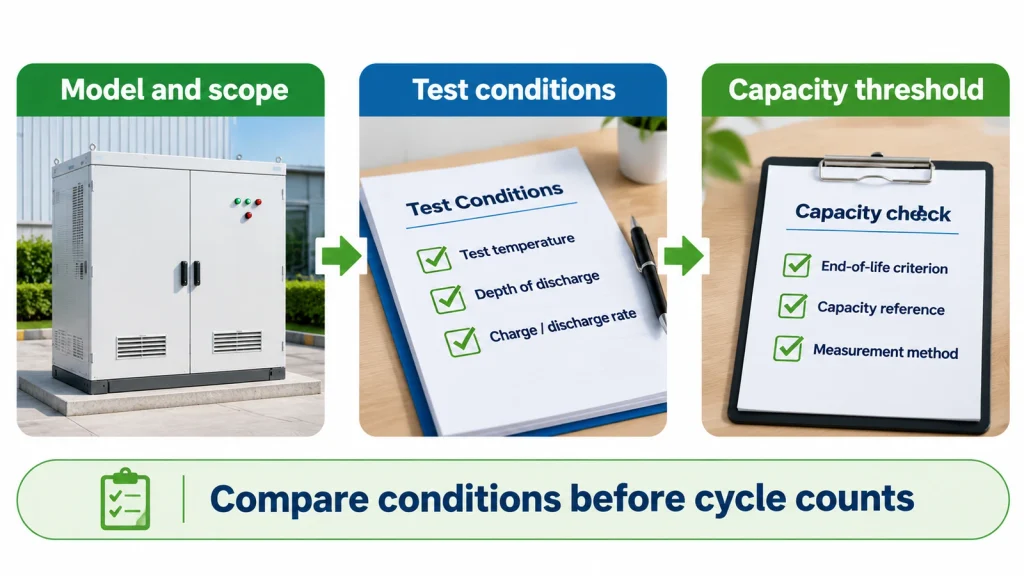
Check the test temperature, depth of discharge, charge and discharge rate, and end-of-life criterion. Those details establish a basis for comparison. If a document offers only a number or a long-life claim, ask the manufacturer for the missing definitions. The permitted operating-temperature range is not automatically the temperature used for a cycle-life test.
For example, a model specification reviewed for this article lists at least 8,000 cycles alongside 25°C, 0.5P, 90% DOD and 70% EOL. The number must stay attached to those conditions and the models covered by the document. Preserve the original 0.5P notation pending clarification; do not silently replace it with 0.5C. A 90% depth of discharge is not 90% round-trip efficiency.
The Victron Lithium Smart technical data also lists cycle life with depth of discharge and a remaining nominal-capacity threshold. It supports reading the conditions, not treating different manufacturers or product classes as equivalent. Comparing a larger headline count against a smaller one does not establish a better product when the test basis differs.
Define What the End Point Means
Ask the manufacturer to define the capacity reference, measurement method and acceptance conditions behind the EOL percentage. Reaching a specified capacity threshold is not the same as suddenly stopping that day, and it does not establish that the original load requirement can still be met. State the minimum delivered energy the business needs separately.
If a project must support a later shift after years of operation, ask the proposal to explain its capacity-retention assumptions. Do not enlarge the battery by an arbitrary percentage. The usable battery capacity guide separates nominal capacity from usable energy; a cycle-life claim does not replace that assessment or establish future load-side energy by itself.
Separate Cell Life From System Service Life
Record a cell cycle-life claim separately from a system specification. Even when both display the same number, that does not establish the service life of the PCS, cooling equipment, contactors, controls or communications hardware. It also does not establish that the complete installation needs no maintenance. Ask what equipment and test boundary the rating actually covers.
If the quoted cell or configuration changes, review whether the supporting document still applies. Do not complete a missing temperature, DOD or EOL condition for one model by copying it from another. Keep the model designation and document revision beside each quoted figure so later substitutions remain visible.
Do Not Turn Cycle Counts Directly Into Years
Dividing a cycle count by an assumed daily frequency produces an arithmetic result, not a demonstrated project lifetime. Ask how cycles are counted, how partial charging and discharging are handled, and how elapsed time, temperature and operating conditions are included in the manufacturer’s forecast. Do not assume the dashboard counter uses the same definition as the test report.
The owner should provide the operating schedule and available records for assessment by the BESS manufacturer. A new project can use clearly identified design scenarios where measurements do not yet exist. Keep those scenarios separate from measured history, and do not describe a forecast as a proven service life.
Match BESS Battery Cycle Life to the Operating Plan
Routine tariff shifting needs a defined discharge schedule, power requirement and recharge window. Solar-surplus shifting needs evidence that surplus energy is actually available. Occasional outage backup also needs standby and recovery requirements. These applications should not all be assigned the same assumed number of cycles per day simply to produce a lifetime estimate.
When storage serves both tariff shifting and backup, define the reserve priority. Records should identify relevant periods, charge and discharge activity and temperature. The BESS remote monitoring guide helps organise those requirements. A dashboard cycle counter alone does not validate the manufacturer’s lifetime claim or establish how much capacity remains.
Put the Evidence in One Comparison Table
Complete the following worksheet for each quotation. Mark missing items as unconfirmed rather than filling them with an assumed industry average.
| Review item | Information to confirm |
|---|---|
| Model and revision | Model, cell and document revision |
| Test boundary | Cell, pack or system |
| Test conditions | Temperature, DOD and rate definition |
| Capacity threshold | Reference, measurement method and EOL definition |
| Site duty | Dispatch, reserve and recharge windows |
| Evidence | Applicable report and open items |
| Warranty | Term, scope and capacity provisions |
Review Warranty Separately
A cycle-life rating does not automatically create a free-replacement commitment. Review the written warranty for its term, covered equipment, any capacity provisions, operating limits and required claim records. Do not infer warranty years from a cycle count or present one supplier’s service arrangements as a rule shared across the industry.
Buyer Questions
Is a Higher Cycle Count Always Better
Not necessarily. First establish whether the models, test conditions and capacity thresholds are comparable. Then assess whether the documented performance matches the site’s operating objective. A higher number with missing conditions is not a complete purchasing argument.
Do Missing Conditions Prove a Poor Product
No. Missing conditions identify an evidence gap, not proof of poor performance. Request the applicable technical explanation or report before accepting a comparison. A brochure is a starting point, not a substitute for the agreed specification.
Key Takeaway
BESS battery cycle life is useful when the model, test conditions, capacity threshold and operating objective are clear. Compare the evidence before comparing headline counts. Where information is missing, resolve it before making service-year or investment claims.
When reviewing battery energy storage systems, provide the site location, load and dispatch schedule, charging sources and quoted equipment models for assessment by the BESS manufacturer.
Found this helpful? Share it with your network.
👇