
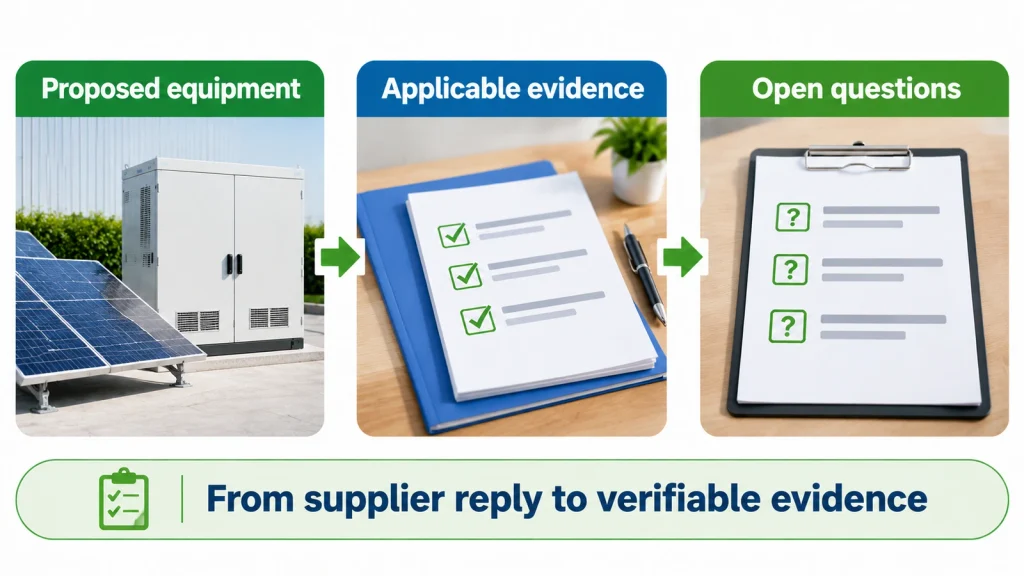
Choosing a solar and battery storage supplier in Africa starts with the proposed equipment, the records behind it and the supplier’s answers to site-specific questions. A broad catalogue, a quick reply or a large battery capacity does not establish that a package fits the project. Compare how each candidate explains and supports the same operating requirement.
This guide is for business and EPC buyers reviewing supplier responses for African projects. It follows the equipment offer through model checks, compatibility evidence and a practical comparison worksheet. It is not a brand ranking, and it does not assume that every supplier maintains local stock, an installation team or a service office in the destination country.
Table of Contents
Establish What the Supplier Is Actually Offering
When an offer describes a complete solar and storage system, check whether it identifies the battery, PCS or inverter, PV equipment and controls. Separate existing equipment from new supply and items that must be purchased separately. The question is whether the proposed arrangement is understandable, not how many products appear in the catalogue.
Give candidates the same basic project information. Otherwise, one may quote for all loads while another assumes only critical equipment. The BESS procurement documents guide helps prepare that common brief. Once responses arrive, review how each supplier has interpreted it. A lower price can reflect a different scope rather than a more suitable offer.
Move From Brand Names to Exact Models
Ask for equipment model designations and document revisions. A battery brand, a cell brand and the manufacturer of the complete system refer to different parts of the supply chain. A brand appearing in a brochure does not establish the configuration of the quoted equipment. The model list should let a buyer trace each important claim to the relevant document.
If a supplier proposes an alternative model, ask what changes in power, energy, communication and the intended operating arrangement. Missing documents can remain open while the enquiry develops. They should not be counted as confirmed compliance simply because a replacement is described as equivalent. Preserve the earlier revision so changes can be reviewed.
Check the Equipment Combination Not Just the Interface
PV, LFP batteries, inverters and controls can each have valid specifications without the combination supporting every requested function. Ask the supplier to explain whether the proposed equipment arrangement supports the required operating mode and what documentation supports that answer. An interface name alone is not a complete compatibility assessment.
The Victron battery compatibility guidance distinguishes information about tested batteries from guidance for batteries outside that list. It does not treat every unlisted battery as incompatible. This illustrates the value of combination-specific information. It does not establish that a Solaura product has been tested by Victron or that another manufacturer follows identical requirements.
Ask Each Candidate the Same Operating Question
Choose one situation that matters at the site, such as a grid interruption during daytime production. The owner should identify the loads that need support and the acceptable interruption conditions. Ask each candidate how the proposed arrangement addresses that situation, what site information is still needed and which functions remain unconfirmed.
A useful response goes beyond yes. It explains the proposed sequence at a level the buyer can review and identifies limits or prerequisites. This is a review of the explanation and evidence, not an invitation to disconnect a working installation. Electrical design, protection and site testing require suitable professionals and an approved plan.
Separate Demonstrations From Verification Records
Project photographs, monitoring screens and test videos can help explain an offer, but check which model, configuration and function they show. Successful operation at another site does not by itself establish the performance of the current quotation. A supplier should be able to explain what the example demonstrates and what it does not.
Factory records can support review of agreed tests, while site performance still depends on installation and operating conditions. The BESS factory acceptance testing guide helps organise the questions to ask. Receiving a report is not the same as completing verification for the current project. Match the report scope to the function being discussed.
Keep Evidence and Open Questions in One Table
When comparing a solar and battery storage supplier in Africa with other candidates, use the worksheet below rather than an unsupported numerical ranking. Missing information calls for clarification; it does not automatically prove poor equipment. Equally, a verbal assurance should not be treated as the same evidence as an applicable written record.
| Review item | Information to confirm |
|---|---|
| Supply scope | Existing and new equipment |
| Models | Models and document revisions |
| Compatibility | Evidence for the proposed combination |
| Operating objective | Site scenario and technical response |
| Verification | Record scope and limitations |
| Technical support | Contact, documents and support arrangement |
| Open questions | Unconfirmed items and next step |
Look for Answers That Resolve the Purchasing Question
A useful technical answer separates confirmed capabilities from owner inputs and checks still required. A supplier that clearly identifies an unmet condition may provide more decision value than an unconditional assurance. Look for responses that close specific questions, not merely longer presentations or repeated claims that every requirement can be met.
For cross-border supply, confirm the technical contact, document language and proposed support arrangement. Selling into Africa does not establish that a supplier has a warehouse or resident team in the project country. Requested arrangements should appear in the proposal. This article does not prescribe a universal service model or response-time promise.
Buyer Questions
Does a Larger Product Range Make a Better Supplier
Not necessarily. Prioritise the fit of the proposed equipment combination and the supplier’s ability to support it with applicable information. Catalogue breadth is useful only when it helps address the actual project requirement.
Should a Supplier Be Rejected for a Missing Public Report
Not on that fact alone. Check whether the requested document applies, whether it can be provided for review and whether its scope matches the equipment. Evidence needed for the purchasing decision should remain unconfirmed until it is available.
Key Takeaway
Choose a supplier around a defined project. Check the proposed models, equipment combination, applicable evidence and technical answers before treating offers as comparable. Resolve important open questions before making the purchasing decision.
When reviewing battery energy storage systems, provide the project location, existing equipment, load requirements and intended operating mode for assessment by the BESS manufacturer.
Found this helpful? Share it with your network.
👇