A scalable BESS needs a verified route to future expansion, not just a modular label. Commercial buyers should separate future energy needs from power requirements and confirm which equipment and controls can grow together. Before ordering, establish the manufacturer-approved configuration, any timing limits and the site requirements instead of assuming batteries can be added whenever needed.
This guide starts with changes in demand, separates power from energy, and uses an illustrative project to build a phased requirements table. It then explains what to get in writing from the supplier. It is a purchasing guide, not an installation or rewiring procedure.
Table of Contents
Start with the Change in Demand
A warehouse staying open later has a different expansion need from a factory adding a motor. The first may mainly need more operating hours. The second may also need more simultaneous power and starting capability. Describe the equipment, operating schedule and essential loads before discussing extra cabinets.
For a scalable BESS, keep confirmed requirements separate from forecasts. If phase-two equipment is not yet selected, record the timing assumptions and demand range rather than treating a forecast as a guarantee. The BESS sizing guide explains how to establish the initial load and backup-time estimate.
Separate Longer Runtime from Higher Power
Energy Defines How Much Must Be Delivered
kWh describes energy over time. In a simplified case with a constant load and no other supply, a 20 kW load running for four hours needs 80 kWh delivered to that load. That is not the battery nameplate capacity. Equipment sizing must also account for usable capacity, losses, auxiliary consumption and operating reserve.
Power Defines What Can Run at the Same Time
kW describes power. Adding battery energy does not by itself establish a higher output rating for the existing PCS or inverter. Ask the supplier to check battery current limits, conversion equipment, controls and power limits in the intended operating mode. Longer runtime also needs a charging plan: can the available supply recharge the system before the next operating period?
The SMA Storage XL expansion manual treats added battery energy and increased charging and discharging capability separately and refers to system limits. This illustrates why buyers should ask about both. It is not a configuration guide for Solaura equipment or proof of compatibility between brands.
Plan a Scalable BESS in Two Phases
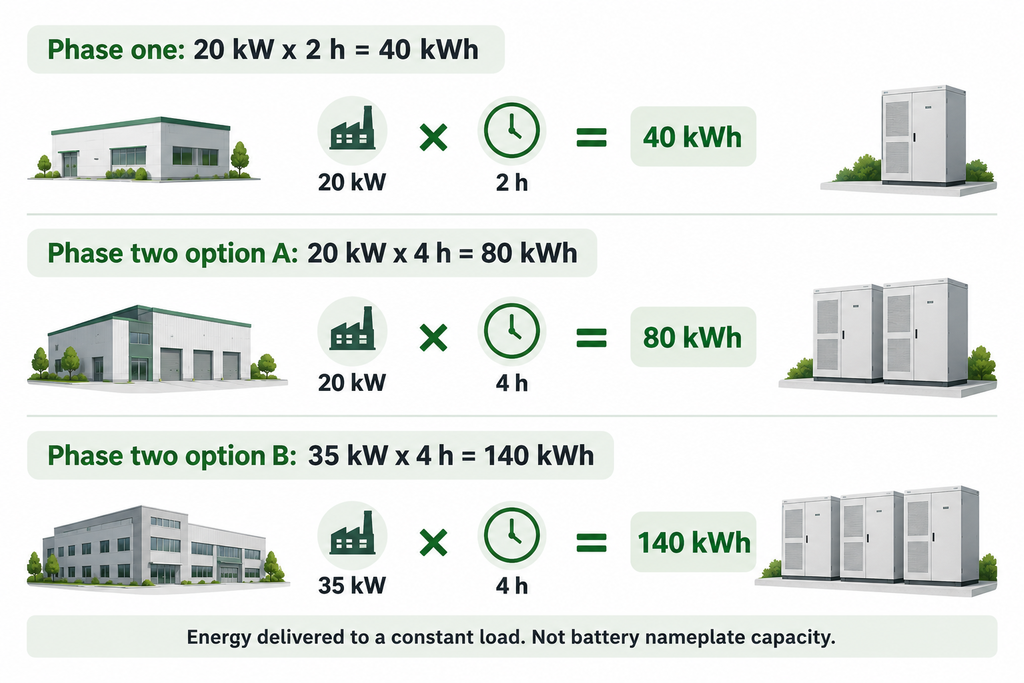
The table below is an illustrative requirement, not a customer case or equipment recommendation. It assumes a constant 20 kW critical load in phase one. Phase two could extend backup time at that load or increase it to 35 kW. An engineer must still verify the actual load profile, startup conditions and required system capacity.
| Scenario | Constant load | Duration | Energy at load |
| Phase one | 20 kW | 2 hours | 40 kWh |
| Phase two option A | 20 kW | 4 hours | 80 kWh |
| Phase two option B | 35 kW | 4 hours | 140 kWh |
Option A focuses on duration, while charging and equipment limits still need review. Option B raises both power and energy demand, so extra batteries alone may not address conversion and distribution limits. Do not use 40, 80 or 140 kWh from this table as the rated battery capacity to order.
Confirm the Expansion Conditions Before Ordering
A modular design does not necessarily allow an upgrade years later. The SMA battery extendability table for Storage-30-20 and Storage-50-20 lists a six-month limit after commissioning for adding battery cabinets. That restriction is specific to the documented products, not all BESS. It shows why the permitted expansion window belongs in the purchasing record.
For the proposed scalable BESS, request the exact model and manual revision rather than accepting a simple statement that parallel operation is possible. The questions below are purchasing prompts, not a claim that every system offers these capabilities.
| Review area | Written answer to request |
| Approved combination | Permitted models, quantity, firmware and configuration revisions |
| Existing battery conditions | Whether age, condition or upgrade timing imposes restrictions |
| Power and controls | Whether PCS, metering, communications or control changes are required |
| Site provisions | Space, access, distribution and approval provisions |
| Responsibilities and costs | Who reviews, commissions, updates warranty records and plans downtime |
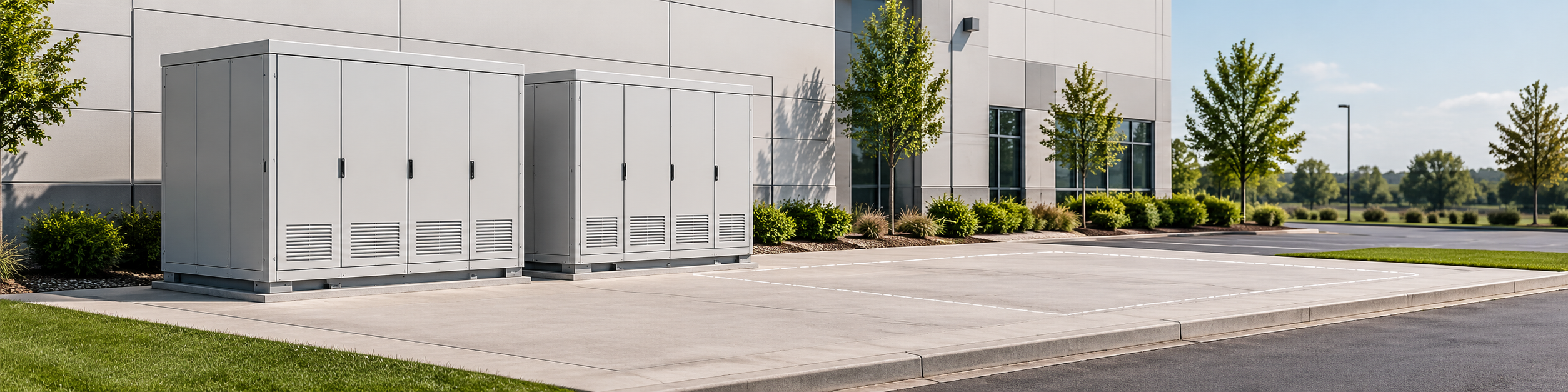
The Solaura 100 kW 209 kWh BESS product page describes project-specific multi-cabinet expansion and calls for engineering confirmation of cabinet count, protection, cabling and controls. That page alone does not establish compatibility for adding cabinets years later. Obtain written confirmation of timing, configuration and warranty conditions for the proposed project.
Decide What to Reserve Now and What to Buy Later
Phased procurement may defer some equipment spending, but it can also bring a second delivery, commissioning visit, shutdown or redesign. Ask the supplier to separate phase-one equipment, provisions needed now and items still to be confirmed for phase two. Without project quotations, staged purchasing cannot be assumed to cost less overall.
If future demand and timing are uncertain, assess both an approved integrated upgrade and the feasibility of a separate storage block. Each needs design review. This guide does not recommend mixing old and new batteries or different brands without manufacturer approval.
Add the agreed expansion path to the project file, including models, constraints, open items and responsible parties. The BESS procurement documents guide covers the wider enquiry package; this article focuses on future expansion decisions. Qualified personnel should perform installation and modifications under an approved design.
Buyer Questions
Can More Battery Cabinets Be Added Later?
Only where the model documentation and project design allow it. Confirm the approved combination, timing window, condition of existing equipment and any recommissioning requirements. A scalability claim alone is not approval to proceed.
Does Doubling Battery Capacity Double Output Power?
Not automatically. Output depends on the ratings and operating limits of the complete system, not battery kWh alone. Confirm usable energy and output power separately for the expanded configuration.
Key Takeaway
A scalable BESS is useful when its expansion path can be checked. Separate runtime from power needs, then confirm configuration, timing, site provisions and responsibilities. With those conditions documented, phased procurement becomes an actionable plan rather than an assumption that an upgrade will always be available.
For a Solaura project review, provide the location, current and forecast loads, backup duration, expansion timing and any existing equipment models. Available configurations, expansion options and services must be confirmed through the project review and quotation.
Found this helpful? Share it with your network.
👇