
BESS in hot climates should be selected on more than battery capacity or a maximum operating temperature. Buyers need evidence of sustained output under site conditions and a clear account of cooling and other auxiliary energy use. For commercial projects in Nigeria and other hot locations, the aim is not to choose the highest temperature printed on a brochure. It is to establish what the system can deliver during the hours that matter.
This guide follows demand through a hot working day, then explains how to read temperature specifications, account for auxiliary energy and turn missing performance conditions into useful quotation questions. Numerical examples illustrate a method; they are not Solaura specifications or project results.
Table of Contents
Why This Question Matters Now
The CATL discussion of storage reliability, published on 15 October 2026, highlights high-temperature operation and auxiliary consumption. It provides a timely industry context for this purchasing question, but it is a manufacturer statement, not an independent performance test or proof that one cooling method is always better.
Start with the Hours When Power Matters
Consider a commercial site that needs battery support for afternoon production. Put its load records alongside temperature data for the proposed equipment location, rather than relying on the city’s annual average. Ambient air, internal equipment and battery temperatures are different measurements. Ask where the temperature is measured and under what conditions.
Record whether the installation is indoors or outdoors, whether it is shaded, whether nearby equipment discharges hot air and whether the layout meets the manufacturer’s requirements. Where measurements are unavailable, label temperature as a design assumption rather than a measured result. The BESS sizing guide helps organise load and backup duration; this article adds the question of whether those needs can be met during hot periods.
An Operating Range Is Not a Sustained Output Guarantee
SMA temperature derating guidance documents reduced output due to excessive temperature for its Sunny Island equipment. This supports checking model-specific derating information; it does not establish the trigger temperature or reduction percentage for another brand. An assessment of BESS in hot climates should examine battery and power-conversion limits separately.
The Victron battery technical data list nominal capacity at a specified temperature separately from charge and discharge temperature ranges. These fields describe different things. Its small-battery specifications should not be transferred to a commercial storage cabinet. Ask for the same clarity of conditions for the complete system being quoted.
If a quotation gives only a maximum operating temperature, ask for the permitted continuous power, duration, state-of-charge range and any different charging limits at that condition. Missing information does not automatically mean poor equipment. It means the comparison is not yet complete.
Put Cooling Energy on the Right Side of the Meter
When comparing BESS in hot climates, first identify where delivered energy is measured. Figures at the battery DC terminals, PCS AC terminals and site connection point are not directly interchangeable. Ask how cooling, controls and other auxiliaries are supplied, and whether their consumption is already included in the quoted energy or efficiency figure.
The following is an accounting example only. Suppose the PCS supplies 200 kWh measured upstream of the auxiliary branch, and auxiliaries on that same supply path consume 8 kWh during the interval. Ignoring other downstream losses, 192 kWh reaches the business loads. The 8 kWh is neither a typical value nor a measured cooling result.
| Item | Assumption |
| AC output before auxiliaries | 200 kWh |
| Auxiliary consumption in the interval | 8 kWh |
| Energy reaching business loads | 192 kWh |
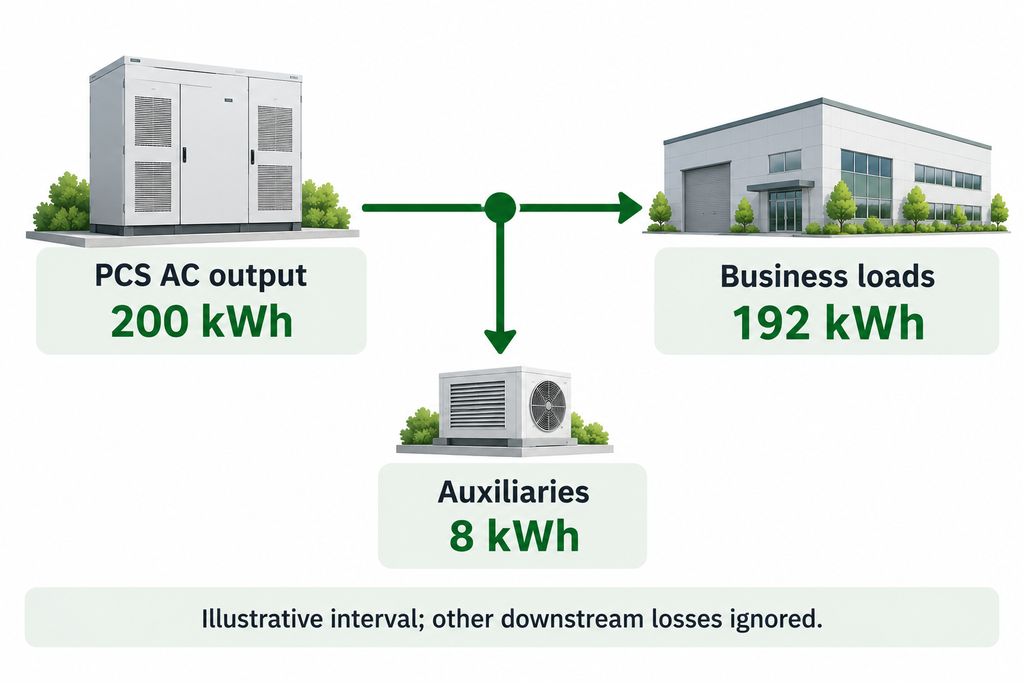
If the quoted 200 kWh is already net delivery measured after the auxiliary branch, do not subtract 8 kWh again. If auxiliaries use a separate supply, account for that energy and cost separately. The example also cannot establish round-trip efficiency because charging input at a matching boundary has not been provided.
Do not treat cooling nameplate power multiplied by every hour of the year as a reliable annual consumption forecast. Request operating modes, cycling or speed-control assumptions, and auxiliary energy during charging, discharging and standby. Any financial assessment should use data consistent with the site’s operating schedule.
Assessing BESS in Hot Climates with Comparable Data
Evaluating BESS in hot climates does not require choosing a winning cooling label first. Air cooling and liquid cooling describe design approaches. A purchasing decision still needs whole-system performance information, applicable conditions and maintenance requirements. The table below organises evidence gaps; it is not a certification checklist or an equipment acceptance procedure.
| Evidence | What it should show |
| Temperature record | Sensor location, interval and measured or assumed status |
| Output performance | Quoted model, temperature, continuous power and duration |
| Charging conditions | Allowed charging power at the stated temperature and state of charge |
| Energy boundary | Meter location and treatment of auxiliaries and other losses |
| Installation conditions | Manufacturer requirements for space, ventilation and maintenance |
If two quotations use different temperatures or meter locations, request a common basis before comparing the numbers. Where that is not possible, state the differences rather than producing a misleading ranking. If a derating curve is unavailable, ask whether a test report or confirmed performance table covers the relevant conditions.
Turn the Site Conditions into a Useful Enquiry
Provide the location, critical-load hours, backup duration, installation position and available temperature records. Mark unknowns clearly. The BESS procurement documents guide can help organise the enquiry attachments. Temperature conditions belong alongside the load requirement, not as an afterthought once capacity has been chosen.
Use the available battery energy storage systems as a starting point for discussing the product scope, then obtain performance conditions for the quoted configuration. Do not alter cooling arrangements, protective settings or equipment clearances to chase higher output. Qualified personnel should confirm the site design against the manufacturer’s documentation.
Buyer Questions
Does Hot Weather Automatically Require a Larger Battery?
No. First establish whether the constraint concerns delivered energy, continuous power, cooling conditions or installation. Adding kWh does not resolve every temperature-related limit.
Can Another Brand’s Temperature Data Be Used for the Project?
It can help frame questions, but it cannot replace performance information for the proposed model. Equal rated capacity does not establish identical cells, PCS equipment or thermal design.
Key Takeaway
Selecting BESS in hot climates comes down to a consistent, verifiable basis: site temperature, sustained output, operating duration and the auxiliary-energy boundary. Establish those conditions before comparing capacity and price. That is a stronger basis for a decision than a maximum temperature or cooling label alone.
For a Solaura project review, include the location, load schedule, installation photos and any temperature records. Configuration, performance conditions and service scope remain subject to the verified project proposal and quotation.
Found this helpful? Share it with your network.
👇