

LFP battery usable capacity should be compared only after the energy definition, measurement point and operating conditions are clear. Rated energy is not automatically the energy a business can receive at its loads. Establish the battery operating window, reserve and losses already included in the quote before estimating delivery. Otherwise, a comparison can either overstate backup time or deduct the same allowance twice.
This guide follows the capacity fields in a quotation, separates usable DC energy from AC delivery, and provides an illustrative calculation and a purchasing worksheet. It is not an electrical design or a performance promise for a Solaura model. Start with the definition of each figure rather than choosing a universal deduction percentage.
Table of Contents
Start With the Meaning of the Quoted Capacity
A kWh figure may describe nominal battery energy, energy available within a defined operating window, or output at a specified AC measurement point. The same unit does not make those quantities interchangeable. Ask the supplier to identify the model, configuration and document revision beside each figure. A quotation that only says capacity leaves an important question unanswered.
The Victron battery technical data list capacity at specified temperatures, nominal energy and discharge-current conditions separately. This is a useful example of how specifications disclose their conditions, not a source of performance values for a commercial storage cabinet. Do not transfer another manufacturer’s capacity or efficiency figures to the system being purchased.
Check Whether the Operating Window Is Already Included
For LFP battery usable capacity, check whether the published usable figure already reflects the allowed state-of-charge window. Applying a depth-of-discharge factor again may count the same restriction twice. Ask how the upper limit, lower limit and backup reserve are defined, and whether the quoted usable energy already includes that reserve.
A reserve kept for outages may differ from the system’s protective lower limit. Clarify whether the quote describes routine operation or emergency support. Do not change protective settings to investigate the difference. State of charge is an estimate; a percentage alone is not a precise energy measurement under every operating condition.
Follow the Energy to the Delivery Point
Usable DC energy and AC energy delivered to loads can differ because of conversion, wiring and auxiliary consumption. Each allowance must correspond to the actual supply path. If the quoted figure is already net delivery after those items, do not subtract them again. Ask for a simple boundary description that states where energy is measured and which consumers are included.
If cooling is supplied separately, account for that energy separately rather than automatically subtracting it from an unrelated output measurement. The high-temperature BESS guide explains auxiliary-energy boundaries in more detail. For a quotation review, the essential question is whether all suppliers are describing delivery at the same point under comparable conditions.
An Illustrative Calculation With Defined Boundaries
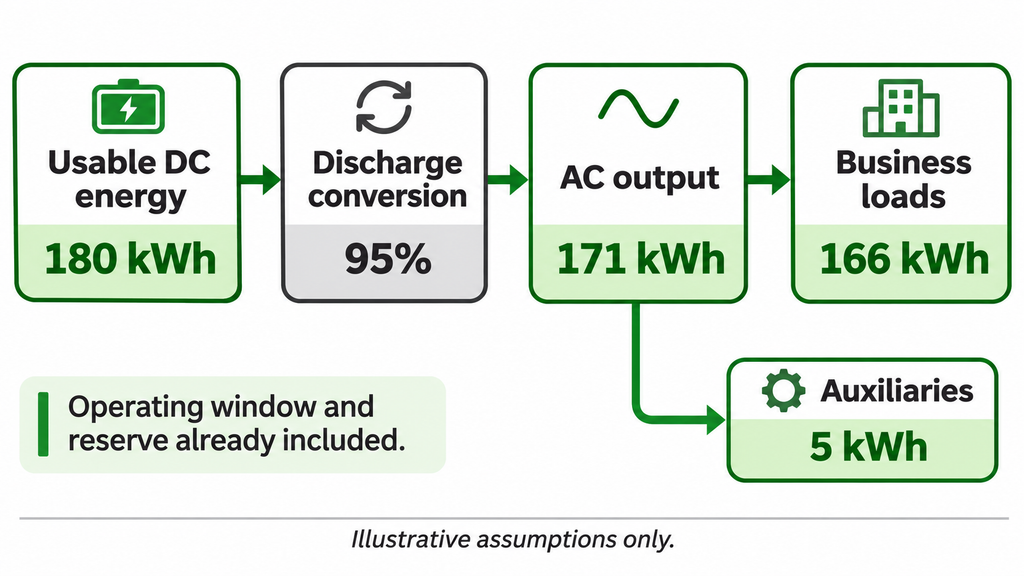
The following assumptions illustrate arithmetic, not typical efficiency or product specifications. Suppose a quote confirms 180 kWh of usable DC energy, already allowing for the operating window and reserve. Assume discharge conversion efficiency from that DC point to the AC output is 95%. Downstream auxiliaries on that supply path use 5 kWh during the interval and are not included in that efficiency. Other downstream losses are excluded from this simplified example.
AC output is therefore 180 × 0.95 = 171 kWh. Subtracting the defined auxiliary consumption leaves 166 kWh for the business loads. The 180 kWh is already usable energy, so no additional depth-of-discharge multiplier is applied. If a quote instead specifies 166 kWh of net delivery at that same boundary, subtracting the 5 kWh again would be incorrect.
Discharge conversion efficiency is not round-trip efficiency, which concerns a complete charging and discharging path. Do not insert a round-trip value into this calculation as though it were the one-way conversion factor. Nor does this example establish actual backup duration: the operating power, load pattern and equipment limits still need verification.
Compare LFP Battery Usable Capacity on One Worksheet
Use the worksheet to compare LFP battery usable capacity on a consistent basis. Leave missing information marked unconfirmed instead of filling it with an industry average. The table is a request for comparable evidence, not a performance ranking of suppliers. Keep the completed sheet with the quotation revision so later changes remain visible.
| Quoted field | What to confirm |
| Energy definition | Nominal, usable DC or net AC energy |
| Operating window | SOC limits and reserve already included |
| Measurement point | DC terminals, PCS output or load connection |
| Deductions | Conversion, auxiliaries, wiring and boundaries |
| Conditions | Temperature, power, equipment condition and test method |
| Evidence | Model, document revision and guaranteed or estimated status |
Enough Energy Does Not Establish Enough Power
A larger energy allowance does not automatically meet a compressor’s starting demand or several production loads running together. kWh addresses energy; kW and short-duration capability address output at a particular moment. Check continuous output, starting requirements and any temperature-related limits separately before treating an energy figure as a backup commitment.
Use the BESS sizing guide to establish an initial requirement from loads and target duration. This article checks whether the supplier’s energy figure describes delivery at the same boundary as that requirement. Also confirm the expected charge level when support begins and the opportunity to recharge before the next operating period.
Buyer Questions
Does Usable Capacity Stay the Same?
No fixed value should be assumed across all conditions. Identify equipment condition, temperature and discharge conditions, and distinguish beginning-of-life specifications from future performance commitments. A retained-capacity warranty threshold is not a promise of the same daily energy delivery at the business loads.
Should a Quote Be Rejected if Usable Energy Is Missing?
Request the definition and supporting evidence first. Missing information does not automatically prove poor equipment, but it prevents a fair comparison. Avoid choosing a system solely by nominal kWh or price per nominal kWh while the operating window and delivery boundary remain unclear.
Key Takeaway
LFP battery usable capacity becomes useful for purchasing when the boundary, operating window and conditions are stated together. Establish what is already included before applying deductions, and verify power requirements separately. A clearly defined delivery figure is more useful than a larger number without comparable conditions.
When discussing battery energy storage systems with Solaura, provide the site location, load records, target operating period and capacity fields that need clarification. The configuration and supply scope remain subject to the confirmed proposal and quotation.
Found this helpful? Share it with your network.
👇