Unreliable grid power can disrupt a business even when the site has a utility connection. Start by identifying which interruptions affect operations and which equipment needs support, then decide how solar, lithium iron phosphate (LFP) BESS and the existing diesel generator should work together. A designed and verified arrangement may reduce specific disruptions. Installing a battery alone does not guarantee zero downtime or solve every power-quality problem.
This guide is for commercial and industrial sites in Nigeria and other African markets that already have grid supply and a generator. It starts with operational impacts, follows normal supply, outages and restoration, then turns those situations into a retrofit brief. It does not present a completed project, a fixed fuel-saving percentage or a payback promise.
Table of Contents
Start With the Business Disruption
The World Bank enterprise outage indicator draws on business surveys to record firms experiencing outages. It provides context, not proof that every country, business or customer faces the same conditions. A purchasing decision still needs records from the site being assessed, rather than an assumed Africa-wide outage pattern.
A short interruption may trigger a restart, inspection of work in progress or a wait for process conditions to recover. Normal output may resume after grid power returns. Record actual stoppages, rework, rejects, extra fuel and delivery delays. Do not treat every possible consequence as a measured loss, or count the same consequence twice when assessing the business impact.
Separate Outages From Power-Quality Problems
When investigating unreliable grid power, distinguish complete outages, repeated brief interruptions and voltage or frequency disturbances. Equipment trips may also involve the site distribution system or the equipment itself. Have suitable professionals examine electrical records and causes. Do not interrupt production power as an informal test.
Battery runtime and transfer interruption are different requirements. Sensitive controls may need a dedicated UPS or another verified supply arrangement. An ordinary BESS label does not establish seamless transfer, voltage correction or a particular protective function. Correcting a distribution fault may be more useful than adding storage without diagnosing the problem.
Translate the Impact Into Critical Loads
Do not assume backup must cover the whole factory. For each critical function, state whether the objective is continued production, maintaining an essential condition or an orderly shutdown. Include controls, cooling and other dependencies. The following table is a template to complete, not an equipment selection for a particular factory.
| Record | What to enter |
| Function and impact | Equipment or process, observed disruption or loss |
| Supply requirement | Running power, starting demand and concurrent equipment |
| Interruption tolerance | Allowed interruption confirmed for the equipment or process |
| Support scope | Duration, controls, auxiliaries and shutdown needs |
| Evidence gaps | Measurement or document source, date and unknowns |
The critical-load planning guide develops this worksheet in more detail. Here, the next question is which source serves those loads under each supply condition. The goal is a usable operating brief, not another battery-size calculation based only on total nameplate power.
While the Grid Is Available
Solar generates electricity; BESS stores and shifts energy. Match expected or measured solar output to demand in the same periods instead of treating annual generation as energy available for charging. A business with substantial daytime demand can assess direct solar use first. Adding a battery needs a separate operating objective and cost justification.
If storage serves both daily operation and outage backup, define whether backup energy is reserved and how it is restored. Supply priorities depend on loads, source availability and the confirmed control design. A universal solar-first, grid-second, diesel-last sequence may not meet a site’s reliability or operating requirements.
When the Grid Goes Down
Installed solar does not by itself establish solar availability during an outage. The Victron ESS system design manual distinguishes connection arrangements and explains how they affect backup operation in the systems it covers. This supports checking the actual architecture, not assuming that a Solaura configuration has the same functions or ratings.
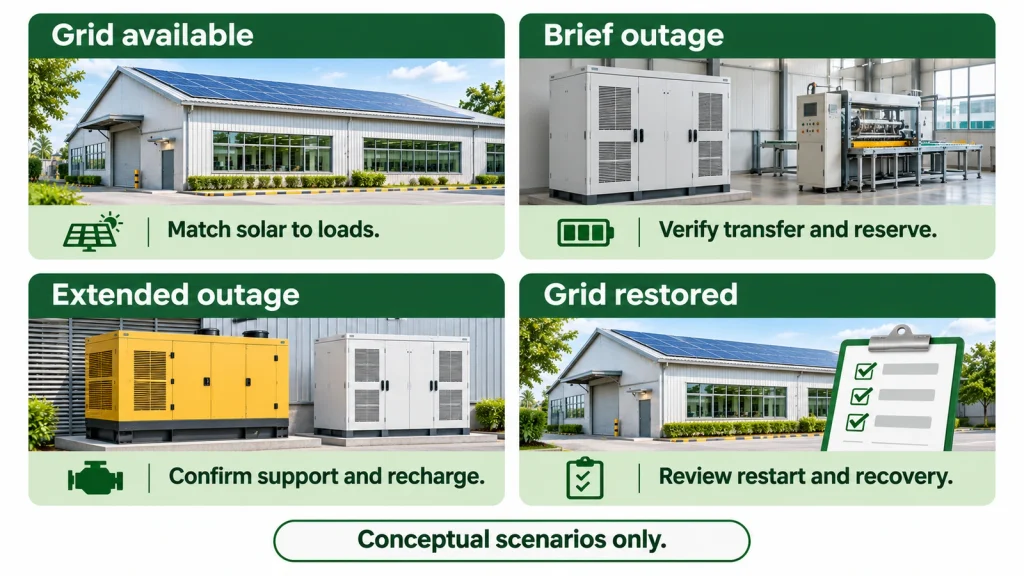
Ask the proposal to explain island operation, supported loads, transfer performance and solar behaviour after grid loss. Confirm separately whether the generator and BESS transfer supply or operate together. The table below lists roles to assess; it is not a wiring diagram or an automatic operating sequence.
| Site condition | Roles and checks |
| Grid available with sunlight | Match PV to current demand; confirm charging headroom and backup reserve |
| Brief outage | BESS supports verified loads; check transfer time and starting energy |
| Extended outage or weak solar | Assess generator support and recharge; battery duration is finite |
| Grid restored | Restore operations under site procedures; assess loads and charging together |
During a Longer Outage
During low solar output or declining battery reserve, the existing generator may still have a role. Check its condition, applicable power capability, control interface and output quality. Adding storage is not a reason to automatically discard usable equipment, or to retain a generator that cannot support the intended arrangement.
The BESS and diesel generators guide explains how loads and recharging share available power. The purchasing question here is whether reserve can be recovered after a long outage and which sources remain available for the next one. Fewer generator hours do not establish the same percentage reduction in fuel use.
After Grid Power Returns
Grid restoration does not mean every machine can restart at once. Follow approved site checks and restart procedures, while assessing whether battery charging and other loads together exceed available supply. Confirm recovery to the intended backup target from records rather than assuming that a short period of grid availability has restored the reserve.
Choose a Response to Unreliable Grid Power
Compare maintaining the existing arrangement while correcting identified faults, adding solar alone, and adding solar with BESS. If current backup already meets the operating requirement, storage may not be the priority. If the problem is a brief transfer interruption, more kWh alone may not resolve it.
Compare alternatives against the same service objective: the same loads, operating periods and reliability requirement. Include equipment, installation, maintenance, fuel, purchased electricity and replacement costs in the assessment. Without project data, a fixed payback claim would be premature.
Buyer Questions
Must Solar and BESS Be Added Together?
Not necessarily. Direct solar use, storage for backup, or another corrective measure may deserve assessment. The choice depends on the actual problem, available charging sources and site conditions, not on a requirement to buy every component together.
Does LFP Chemistry Establish Generator Compatibility?
No. LFP describes the battery chemistry, not the system interface or operating capability. The PCS or inverter, controls, protection, phase arrangement and actual equipment configuration need review before compatibility can be confirmed.
Key Takeaway
A response to unreliable grid power should begin with observed business disruption, assign clear roles to grid supply, solar, BESS and diesel, then compare retrofit options. The objective is to reduce verified supply-related impacts, not to accumulate equipment or promise that every loss can be eliminated.
When discussing battery energy storage systems with Solaura, provide the location, grid and outage records, critical-load worksheet, existing generator and solar information, and acceptable interruption time. Configuration, compatibility and service scope remain subject to the confirmed proposal and quotation.
Found this helpful? Share it with your network.
👇