BESS backup power should protect the production functions that matter during an outage, not automatically keep an entire factory at full output. A properly designed and verified system can support selected processes, essential services or an orderly shutdown for a defined period. It does not automatically guarantee zero interruption, zero rejected products or an immediate restart.
This article starts with possible production impacts, then develops a backup objective, a critical load worksheet and a recovery plan. The scenario illustrates planning choices, not a completed Solaura project. It is not an electrical installation or machine operating guide.
Table of Contents
Production Disruption Can Outlast the Outage
The impact depends on the process. A short interruption may reset controls, stop material movement or disturb a temperature-controlled operation. After power returns, a site may still need to inspect work in progress, reset equipment or wait for process conditions to recover. These are possibilities to investigate, not losses that occur after every outage.
Record the grid interruption and the time from production stopping to normal output separately. Add actual records of rejects, rework, staff waiting or delayed orders where available. Without that evidence, a storage proposal should not claim to prevent a fixed financial loss.
Give BESS Backup Power a Specific Production Goal
One objective is to keep a selected process running. That includes the machine and its controls, cooling, material supply or other dependencies. Another is to hold an essential condition, such as monitoring or an agreed temperature-control function, while main production stops. A third is to provide time for shutdown under established procedures rather than continue producing.
These objectives need different loads and durations. Process requirements and equipment documentation should determine the choice. Safety-related systems require a separate professional assessment; an ordinary storage procurement worksheet does not establish compliance.
Build the Critical Load Worksheet Before Requesting a Quote
Create a record for each item of equipment and use the same record ID for its operating data. Copy and complete the worksheet below. Mark unknowns as to be confirmed instead of working backwards from a preferred battery size. A complete record needs both the production consequence and the electrical requirement.
| Field | What to record |
| Record ID and equipment | Equipment or process name and location |
| Impact and objective | Continue operation, hold a condition or shut down |
| Running demand | Verified kW, kVA, phase arrangement and operating combinations |
| Starting requirement | Manufacturer data or measured current, duration and starting method |
| Interruption tolerance | Maximum acceptable interruption confirmed for the equipment or process |
| Required duration | Target duration and operating pattern |
| Dependencies | Controls, cooling, material supply and other essential services |
| Evidence and gaps | Document, date, measurement conditions and unknowns |
BESS backup power planning needs more than a sum of nameplate ratings. Some loads run together; others operate in stages, and starting demand can differ from running demand. Use verified data to establish simultaneity and supply capability. The BESS sizing guide explains power and energy requirements without treating this worksheet as a final battery selection.
Backing Up the Main Machine May Not Keep the Process Running
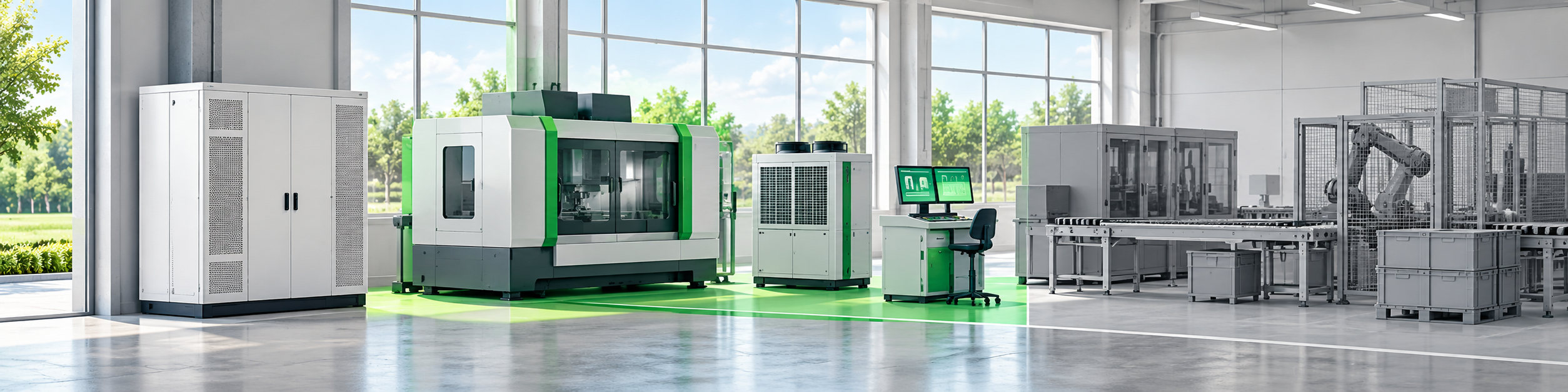
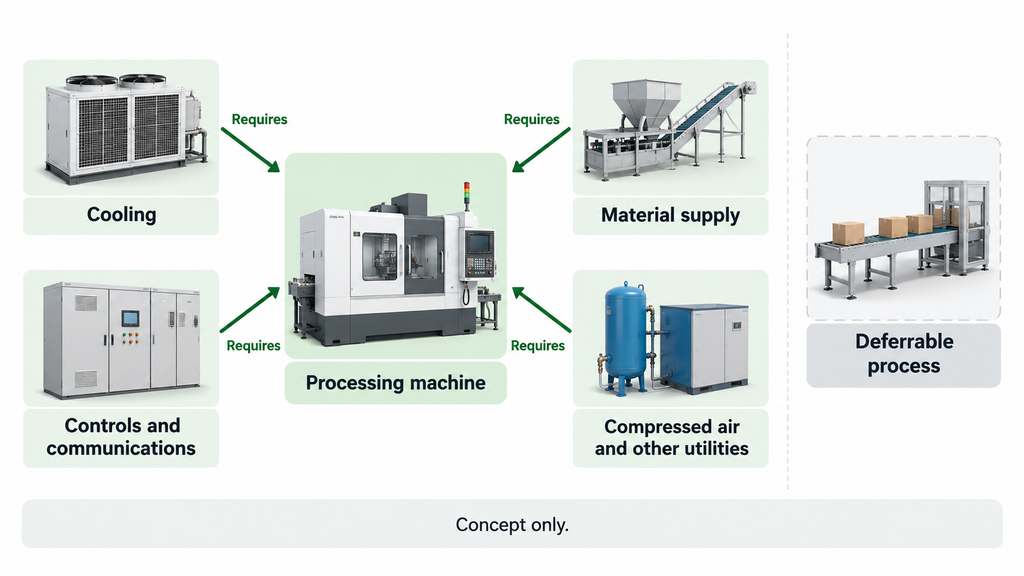
Consider a hypothetical site that wants to maintain a processing operation during an outage. This illustration assumes no product model or measured savings. The main machine is on the backup list, but its cooling pump is not. If the process depends on cooling, supplying the machine alone does not establish that production can continue.
The review should also cover controls, communications, material handling and any other services the process actually requires. The table illustrates the review, rather than specifying which equipment must run at a real factory.
| Assumed item | Question to verify |
| Processing machine | Can it tolerate the planned operating mode and interruption |
| Cooling pump | Must it run whenever the main machine operates |
| Controls and communications | Does a short interruption reset controls or lose state |
| Deferrable process | Can it pause without affecting the selected critical process |
If supporting the whole process exceeds the project scope or budget, an orderly shutdown may be more suitable than continued production. If existing backup already meets interruption and duration requirements, compare the option of adding no storage. BESS backup power is not the necessary answer for every site.
Transfer Time and Runtime Answer Different Questions
Equipment may have enough stored energy for hours of operation but still be unable to tolerate a brief transfer interruption. Check the actual model, operating mode, transfer performance and load tolerance rather than describing an ordinary storage system as a UPS.
The SMA backup operating instructions explicitly exclude loads that depend on uninterrupted supply from the modes described there. This is a limitation of the products covered by that manual, not a universal BESS specification or proof of a Solaura system’s transfer capability.
The Victron ESS system design manual calls for backup inverter/charger sizing to match expected loads and discusses battery discharge-current capability. It supports checking the load against supply capability, not transferring its product ratings to another manufacturer’s equipment.
Plan for Grid Return and the Next Outage
Grid return does not mean every machine can immediately restart together. Follow approved site procedures for inspections, restart order and availability of supporting equipment, and check the resulting supply demand. This article does not provide automatic-restart settings.
Also confirm the energy available when an outage begins and when reserve can be restored afterwards. A battery used for other duties may have less backup energy than its nameplate suggests. Sites retaining an engine can use the BESS and diesel generators guide to examine recharging, without assuming equipment compatibility.
Buyer Questions
Will a Larger Battery Prevent Production Interruptions
Not necessarily. More energy alone does not solve transfer interruptions, insufficient output power or missing supporting equipment. Define the function to preserve before checking the complete supply arrangement.
What Information Helps Before a Quote
Provide the critical load worksheet, outage and recovery records, nameplates and starting data. Include the location, backup objective and existing backup sources. Identify unknowns explicitly rather than presenting them as verified inputs.
Key Takeaway
Plan BESS backup power around critical production functions, not battery capacity alone. Translate outage impacts into defined loads, interruption tolerance, duration and recovery needs. That creates a basis for assessing whether storage can reduce disruption and justify its cost.
For a discussion of Solaura battery energy storage systems, submit the information above. Configuration, supported operating modes and service scope remain subject to the verified proposal and quotation.
Found this helpful? Share it with your network.
👇