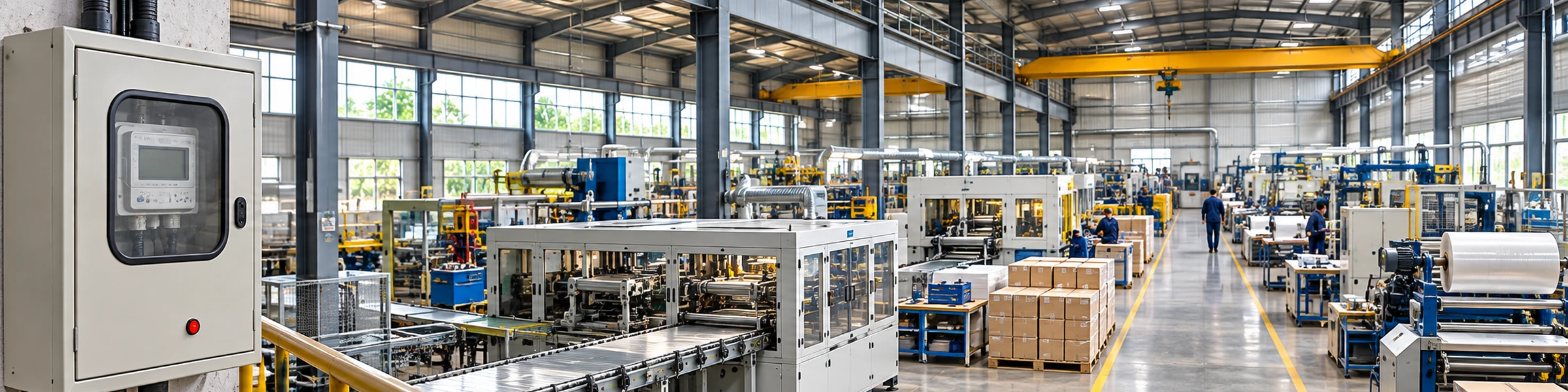
BESS for factories should start with actual electricity use, tariffs, grid conditions and the opportunity for solar, not a battery size chosen in advance. The factory owner should provide or arrange the site information for a BESS manufacturer to assess. Where evidence is missing, further measurement or a site survey should come before a firm capacity, savings or payback claim.
This guide starts with a working day at the factory, then examines the electricity bill, grid supply and solar opportunity. Two worksheets organise the information needed for the next step. They are owner-side preparation tools, not measured customer results or a completed engineering design.
Table of Contents
Start With How Production Changes Electricity Use
Record electricity use during startup, full production, shift changes, overnight operation and shutdown periods. Factories with the same monthly consumption can have different peaks, overnight loads and charging opportunities. Provide records covering representative normal, busy and low-load periods, with dates, time zone and operating status.
Hourly data can reveal the production pattern, but it does not automatically capture billing peaks or motor-starting requirements. kW describes power; kWh describes energy over a period. If a record contains energy consumed in each hour, label it in kWh rather than presenting it as instantaneous power. Short peaks and starting requirements need separate review.
The owner can supply exports from existing meters or monitoring systems. If records are unavailable, mark them as requiring measurement and arrange competent personnel to obtain them. Dividing a monthly bill by working hours does not create a measured hourly load profile.
| Record | Owner input or action |
|---|---|
| Time and production status | Date, time zone, shift and operating status |
| Interval readings | State kW or kWh and interval; awaiting data |
| Peaks and starting demand | Equipment records and measurement; to verify |
| Data source | Meter export, monitoring or survey; flag gaps |
Read the Bill Before Assuming a Saving
Provide the actual tariff contract and bills. Check whether energy rates change by time of day, whether demand or capacity charges apply, and how those charges are calculated. Night production does not mean a lower night-time tariff exists. Rates from another country are not a basis for this project.
The demand-charge research by Clean Energy Group and NREL combines load profiles with tariffs to investigate storage opportunities. It illustrates why an assessment needs more than an equipment price. Published in 2017 for the US market, its price thresholds and market percentages should not be transferred to an African factory.
Even where time-of-use prices differ, the assessment must account for losses, auxiliary consumption, charging windows, equipment costs and backup requirements. With a flat tariff and no relevant demand charge, the proposed benefit needs to be reconsidered rather than assumed to come from tariff shifting.
Separate Grid Access From Usable Supply
The owner should identify whether the factory is connected to the grid, provide connection and transformer information, and record outages and their effects on production. A connection does not establish reliable supply or spare capacity. When power returns, production and battery charging may increase demand at the same time.
Available capacity needs technical review of equipment, load records and any necessary measurements; it is not established by subtracting one reading from a nameplate rating. If there is no grid connection, identify how solar, a generator or another available source would replenish the battery. Storage holds electricity; it does not continuously generate it.
Check Whether Solar Fits the Site and Schedule
A roof or open area does not by itself establish solar suitability. The owner can first provide the location, photographs, area and available building records. Structural capacity, shading, access and electrical integration need further review. An area estimate or photograph alone should not become a promised installation capacity.
Compare expected solar generation with factory demand over the same intervals. If daytime production already consumes most generation, little surplus may remain for charging. Assess non-production weekends separately. A lack of space for solar does not automatically rule out BESS, but its charging source and purpose must be clear.
Assess BESS for Factories With Site Evidence
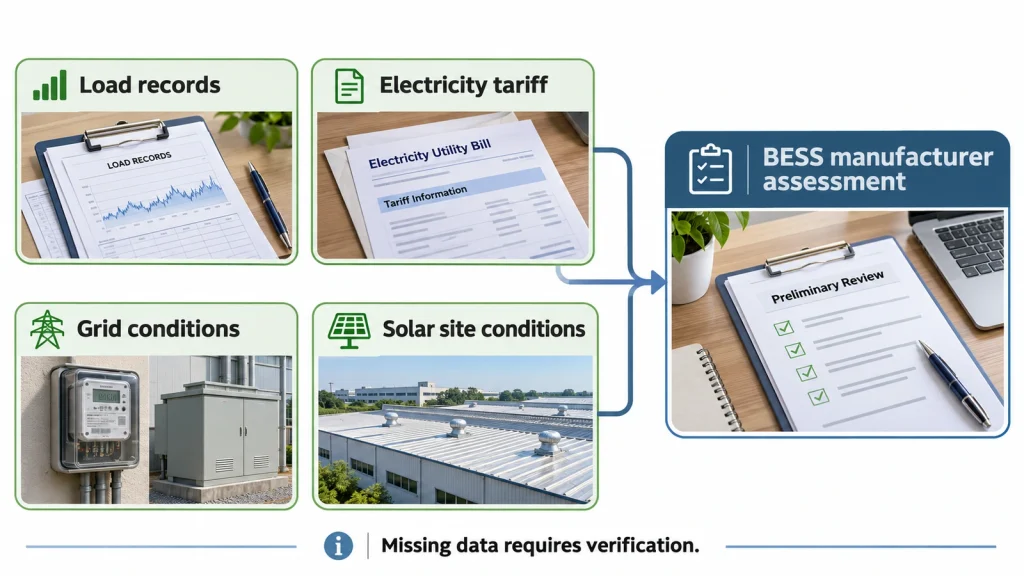
For a factory storage assessment, separate information already supplied by the owner from items needing measurement or professional verification. Complete the status fields for the actual project rather than inserting assumed capacities or prices. A manufacturer’s preliminary assessment does not replace necessary professional design and site verification.
| Site condition | Owner evidence and follow-up |
|---|---|
| Tariff | Bills, contract and billing rules; awaiting data |
| Grid | Connection, transformer and outages; capacity to verify |
| Solar | Location, area and building records; survey needed |
| Existing backup | Generator models and records; interfaces to verify |
| Project purpose | Backup, costs or solar self-use; priority to confirm |
Allow the Assessment to Recommend No Battery Yet
If flexible production can be rescheduled to address the main problem, compare that option with storage. If outages are the concern, define the loads to retain and their interruption requirements first. If recharging opportunities are inadequate, address the supply plan before ordering. Asking about batteries should not predetermine a purchase.
Once the evidence is adequate, the BESS sizing guide can help distinguish power from energy requirements, while the BESS energy management guide addresses operating priorities. This article concerns whether a project deserves further assessment, not the detailed sizing calculation.
Buyer Questions
Can Bills Alone Establish Battery Capacity?
No. Bills explain costs and some consumption information, but may not reveal interval loads, starting requirements or the equipment needed during an outage. Obtain missing evidence or clearly label estimates.
Does the Manufacturer Need Accurate Site Information?
Yes. The owner should supply or arrange the information for preliminary review. Mark missing items as awaiting information, measurement or verification. A manufacturer cannot create measured site results without evidence.
Key Takeaway
BESS for factories should be assessed against load profiles, tariffs, grid conditions and solar opportunities together. The owner supplies the evidence, a BESS manufacturer reviews the options, and qualified personnel address measurement and survey needs. The outcome may be further design, more information or no battery for now.
When assessing battery energy storage systems, prepare the location, production schedule, load records, bills, equipment details and open questions before requesting a preliminary proposal from a BESS manufacturer.
Found this helpful? Share it with your network.
👇