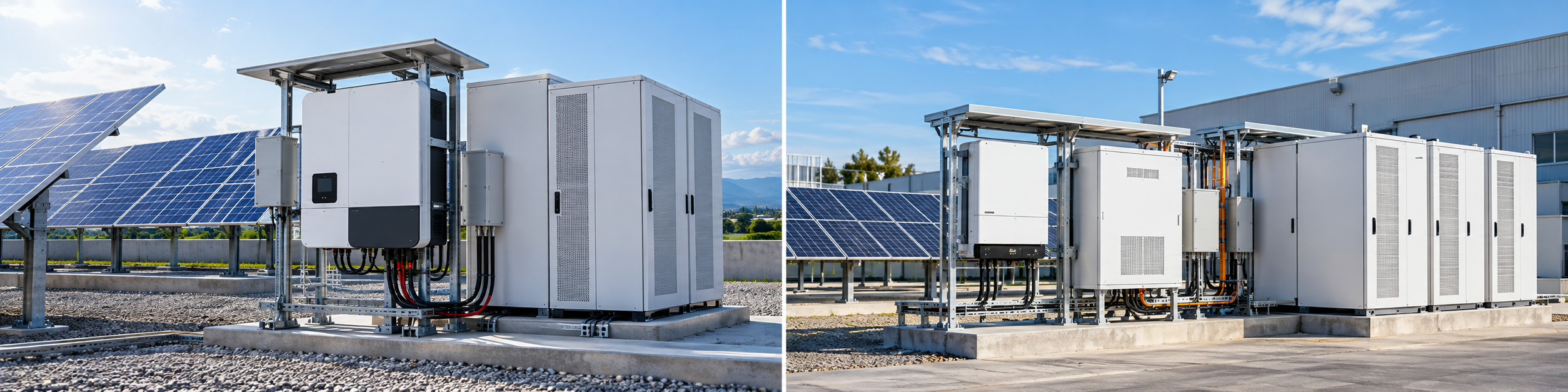
AC vs DC coupled battery storage starts with a practical question: is the project keeping an existing solar installation or designing a new system? AC coupling links the solar and battery systems on the AC side. DC coupling integrates them on the DC side. Neither label alone guarantees backup power during an outage.
For installers, EPC buyers and commercial projects in Nigeria and other African markets, the useful comparison is the complete proposed system. This guide focuses on integration decisions rather than brand rankings or battery sizing. A qualified professional should handle electrical design and installation using the documents for the actual equipment.
What Is the Difference in AC vs DC Coupled Battery Storage?
In a typical AC-coupled arrangement, a PV inverter converts panel output to AC, while a battery inverter manages conversion between the AC system and the battery. A common DC-coupled design uses suitable DC conversion or charge-control equipment and a hybrid or shared inverter stage to supply AC loads. Actual layouts vary by product.
The DOE solar-plus-storage overview explains the two integration routes. It is useful for terminology, not as a current price guide for an African project.
Check 1: Decide Which Existing Equipment Must Stay
For an existing solar site, AC coupling is often worth evaluating because suitable PV equipment may remain in service. That does not mean every existing inverter can be retained. Send the model, firmware, phase arrangement, single-line diagram, panel details and installation records for review before accepting that assumption in a quotation.
The Australian Government battery guide describes AC coupling as a common retrofit route. Its local incentives and installation rules should not be treated as requirements for Nigeria.
For a new project, or one already replacing its inverter, assess a DC-coupled option as well. Ask each quotation to identify retained, replaced and added equipment, plus planned downtime. Keeping an old inverter does not automatically make the whole project cheaper.
Check 2: Specify What Must Happen During an Outage
Treat everyday storage and outage backup as separate requirements. List the circuits to retain, their power demand, the target duration, and whether solar must keep supplying loads and charging the battery during an outage. Adding a battery does not by itself keep an existing PV installation operating when the grid fails.
Ask the supplier to identify the required isolation, control and backup configuration and confirm its limits in writing. Do not assume zero transfer time or whole-site backup. These are procurement questions, not instructions for modifying the electrical installation.
Victron AC-coupling guidance illustrates why PV output and inverter-charger operation need coordination in supported systems. Its equipment-specific limits are not universal settings for other brands.
Check 3: Match Compatibility and Power Limits
Request the exact battery, inverter and controller combination, including communication and software requirements. Matching voltage or a hybrid label is not enough to establish compatibility in every operating mode. Use the hybrid inverter and battery matching guide for the equipment-level checks.
List battery charge and discharge limits, inverter output, PV input and backup output separately. Provide starting requirements for pumps or motors. The BESS sizing guide covers energy and duration; a battery capacity in kWh is not an output rating in kW.
Check 4: Compare Efficiency on the Actual Energy Path
Ask what each efficiency figure measures: PV to load, PV through the battery to load, or grid charging and discharge. Do not compare peak inverter efficiency with whole-system round-trip efficiency. Request the test conditions, auxiliary consumption and relevant operating range.
DC coupling can avoid an AC conversion stage on some solar-charging paths. That does not make every DC proposal cheaper or better at backup than every AC proposal. Ask suppliers to explain their options using the same load profile, generation assumptions and equipment scope, rather than a blanket savings percentage.
Check 5: Compare the Full Quotation and Service Scope
Separate equipment, site alterations, controls, monitoring, installation, commissioning, testing and service in each offer. Ask for planned downtime, responsibility for retained equipment, exclusions and items still awaiting a site check. Compare that scope, not just the battery price.
Use the checklist below to record the differences without choosing a winner in advance. For critical backup loads, request a documented test plan and handover records for the final proposed configuration.
AC vs DC Coupled Battery Storage Comparison
| Check | AC-coupled review | DC-coupled review |
| Existing equipment | Confirm which PV inverter can remain | Confirm replacements and reconfiguration |
| System boundary | Identify PV and battery inverter stages | Identify DC controls and shared inverter stage |
| Outage objective | Confirm isolation, controls and PV operation | Confirm backup configuration and limits |
| Performance | Request data for the same energy path | Request data for the same energy path |
| Responsibility | Assign old and new equipment interfaces | Assign integrated-system responsibility |
FAQs
Does an Existing Solar Inverter Always Need Replacing?
Not always. The supplier should review the exact model and proposed configuration. Ask the quotation to distinguish retention and replacement options rather than deciding from equipment age alone.
Which Coupling Type Is Better for Nigeria?
Country alone does not decide the answer. Compare existing equipment, loads, outage objectives and available service support. The project team should verify the applicable connection and installation requirements.
What Should a Buyer Prepare Before Requesting a Quote?
Prepare the site details, equipment inventory and models, single-line diagram, load records, backup target and delivery scope. Mark missing information as unconfirmed rather than presenting assumptions as verified site data.
Request a Solar Storage Review
Use the BESS procurement documents checklist to organise the enquiry and state whether the project is a retrofit or a new installation. Submit the details to Solaura for an initial supply-scope review. Coupling choice and backup capability remain subject to model checks, site design and the final written quotation.
Found this helpful? Share it with your network.
👇