BESS for depot charging should not be the starting assumption. First check vehicle departure times, charging needs and available supply after other site loads. If a revised charging schedule meets the operating requirement, adding storage may be unnecessary. A battery deserves closer assessment when a defined short-duration power gap remains and there is a realistic opportunity to recharge it.
This guide follows vehicles from arrival through charging and departure, then checks how storage recovers for the next shift. The tables use a simplified hypothetical example. They are not a real logistics project, an equipment recommendation or a savings promise.
Table of Contents
A Logistics Announcement Is a Starting Point
The Kuehne+Nagel and CATL announcement, published by Kuehne+Nagel on 24 September 2026, includes energy storage and charging solutions for logistics sites among its collaboration areas. It shows commercial interest, not completed installations or evidence that Nigerian depots generally need BESS.
This article is for sites already operating electric vehicles or working from a defined fleet purchase and operating plan. Without a real charging requirement, establishing that plan is more useful than buying storage in response to industry news.
Arrival Time Is Not Always Charging Time
For each vehicle group, record arrival, latest departure, required energy and the charging power it can accept. Parked time is not necessarily plug-in time: loading, queues, vehicle movements and occupied bays may shorten the window. Charger count multiplied by nameplate power is not an operating load profile.
The Vector fleet charging overview describes coordination using departure times, vehicle energy needs and site power limits. It is a published example of one supplier’s functionality, not proof that every charger supports it or that Solaura is integrated with that platform.
Test a Schedule Before Adding Hardware
Suppose a site assessment confirms 100 kW of continuous charging headroom from 18:00 to 22:00, after other loads. Two vehicle groups connect at 18:00. Each needs 200 kWh measured at the chargers’ AC inputs before 22:00. Assume the chargers and vehicles can sustain the scheduled power, with no switching or queuing delay.
| Interval | Charging schedule | AC input energy |
| 18:00–20:00 | Group A at 100 kW | 200 kWh |
| 20:00–22:00 | Group B at 100 kW | 200 kWh |
| Total | Four consecutive hours | 400 kWh |
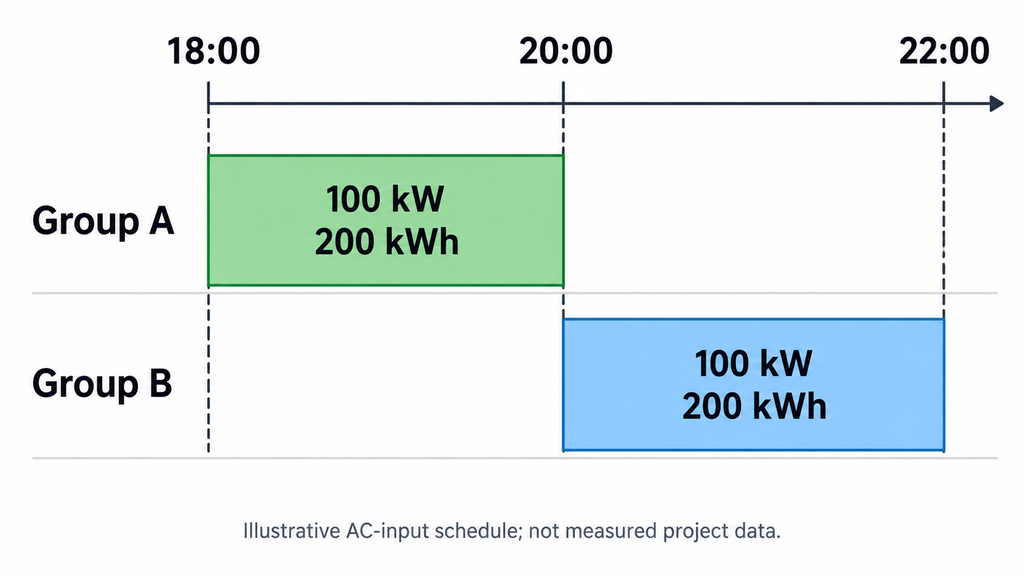
Under those assumptions, charging can finish without BESS. However, the 400 kWh requirement uses the entire four-hour supply allowance, leaving no delay margin. A real plan must check individual vehicle limits, charging taper, changes in other loads and late arrivals.
Here, 200 kWh means demand at the charger AC input, not the net addition to a vehicle battery. If site records describe vehicle-side energy instead, allow for the applicable charging losses before using the table. Do not mix the two boundaries.
When BESS for Depot Charging Becomes Relevant
Using the same assumptions, suppose both groups must now leave at 20:00. Delivering 400 kWh in two hours requires an average charging input of 200 kW. With only 100 kW available from the supply, the gap is 100 kW for two hours, or 200 kWh of supplemental AC energy. This still assumes the vehicles and chargers can operate at that rate.
At this point, BESS for depot charging becomes a candidate, but 200 kWh is not a battery nameplate recommendation. The system must deliver that energy at the agreed AC boundary while meeting power, usable state-of-charge, auxiliary consumption and loss conditions. The BESS sizing guide separates power from energy; the focus here is how departure deadlines change the requirement.
Also examine a supply upgrade, charging elsewhere or a feasible operating change. Storage is not the only option. Without project costs, operating assumptions and applicable local tariffs, there is no basis for claiming it is always cheaper.
Can Storage Recover Before the Next Shift?
BESS for depot charging shifts some electricity use to another time; it does not create energy. Repeated service requires enough spare supply between charging peaks to restore the planned state of charge. Use the headroom actually available while the battery recharges, not the transformer’s total rating.
For example, if only 40 kW is available for battery charging over the next four hours, the AC input is at most 160 kWh. That is already below the previous 200 kWh delivery, even before losses. This recovery plan is insufficient. More battery capacity may postpone depletion, but it does not remove the continuing energy deficit.
An outage-backup objective needs a separate assessment. Owning storage does not automatically allow a charging site to operate through a grid outage. Island operation, transfer arrangements, protection and charger compatibility must be confirmed for the specific design.
Turn Fleet Records into a Project Brief
An enquiry for BESS for depot charging should start with operating records, not just a vehicle count. The following information helps distinguish a short power gap from an ongoing energy deficit or a charging-bay scheduling problem.
| Input | Record |
| Vehicle timetable | Arrival, plug-in availability and latest departure |
| Energy requirement | Energy by group and vehicle-side or AC boundary |
| Chargers | Models, available units and vehicle limits |
| Site supply | Confirmed headroom and changes in other loads |
| Recharge window | Time and headroom before the next cycle |
When discussing battery energy storage systems, identify whether vehicle and charger models are confirmed and whether interface information is available. Support for a communication protocol is not evidence of completed system integration. Confirm the configuration, meter locations and scope of functional testing.
Model future fleet growth as a separate operating scenario rather than simply doubling today’s battery capacity. The scalable BESS planning guide discusses expansion conditions. For each stage, reassess departures, site headroom and the battery recharge window.
Buyer Questions
Can Managed Charging Always Replace Storage?
No. Short windows or limited supply may leave a gap even after rescheduling. Check whether vehicles are ready by their deadlines, not only whether average power appears acceptable.
Should a Depot Buy BESS Before It Has a Fleet Plan?
A possible future charging need is not enough by itself to justify purchase. Site and supply assessments can begin earlier, but storage investment needs a defined energy requirement and use case.
Key Takeaway
BESS for depot charging merits assessment when a defined gap remains after scheduling changes and storage can recover before the next cycle. Start with vehicle timetables and site headroom, then compare storage, supply upgrades and operational changes. The purchasing goal is vehicles ready to depart, not a battery installed without a workable operating plan.
For a Solaura project review, provide the location, vehicle timetable, charger information, load records and supply conditions. Configuration, compatibility and service scope require project-specific confirmation. This article does not promise integration with a particular charging platform or a fixed saving.
Found this helpful? Share it with your network.
👇