BESS for peak tariffs needs an energy budget that protects the agreed outage reserve before assigning energy to daily bill reduction. A battery energy storage system using lithium iron phosphate (LFP) batteries can be considered alongside solar, grid supply and diesel generation, with operation matched to the actual equipment and site. The same stored energy cannot be counted as both already used for savings and still available for backup.
This guide follows the periods before, during and after expensive grid hours. It explains how to check the tariff, allocate stored energy and restore backup readiness. It is for commercial buyers balancing energy cost with continuity of supply, not a universal control-setting guide, a customer savings case or a wiring design.
Table of Contents
Confirm That the Tariff Changes With Time
Start with the current contract, bill and time schedule for the actual supply account. High electricity use during an interval does not necessarily mean a higher unit price. Eskom time-of-use definitions describe energy charges changing by period and season. This South African utility example explains the concept; it does not establish the tariff applicable to a business in Nigeria or another market.
Avoiding expensive energy purchases and reducing a billed demand charge are different objectives. Review energy, demand or capacity, and fixed charges separately. If the account has no applicable time-of-use price difference, reassess this use of storage rather than assuming every bill component can be avoided. Peak demand and peak price may occur at different times.
Define the Backup Job Before the Expensive Period
Define the equipment that must remain supplied during an outage, its required duration and its acceptable interruption. Include controls and auxiliaries, not only the main machine. Start the reserve assessment with the energy and power needed at those loads, then have the designer translate it into requirements for the proposed system. The critical-load planning guide develops that load record.
State of charge, or SOC, is a battery-state indicator, not a guarantee of runtime at the business loads. Available capacity, battery condition, losses and auxiliaries matter. The Victron ESS configuration manual distinguishes a minimum SOC limit while the grid is present from discharge behaviour during an outage. This illustrates the need to verify operating modes, not permission to copy its settings to Solaura equipment.
Allocate Energy Once in BESS for Peak Tariffs
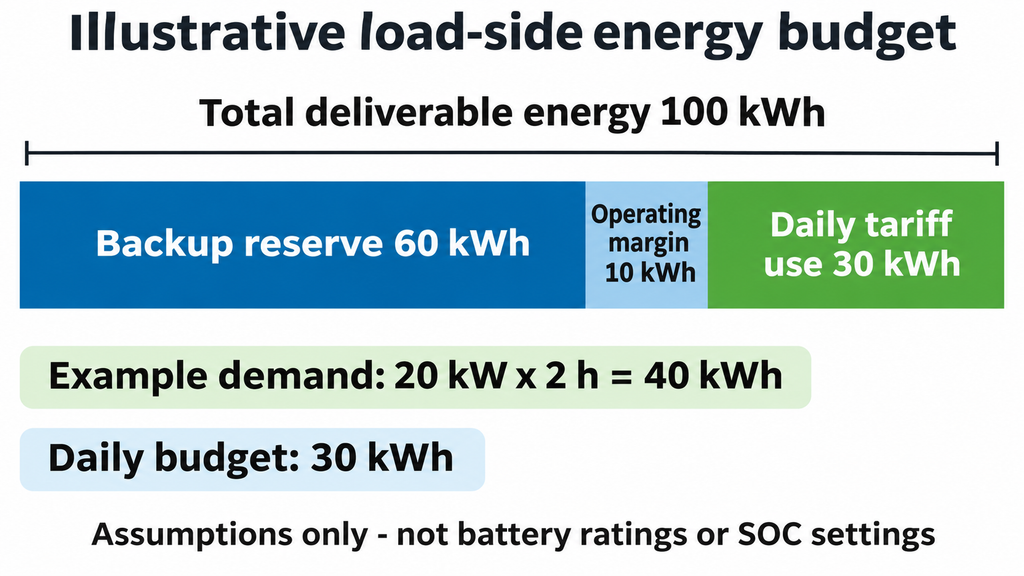
In this purely illustrative example, all energy is expressed at the load boundary. Assume 100 kWh can be delivered under the assessed conditions, with 60 kWh allocated to critical-load backup and a separate 10 kWh operating margin. At most 30 kWh remains in the daily tariff-use budget. These are assumptions, not customer data, a recommended battery rating or SOC settings.
| Energy budget | Assumed load-side energy |
| Total deliverable energy | 100 kWh |
| Critical-load reserve | 60 kWh |
| Separate operating margin | 10 kWh |
| Daily tariff-use budget | 30 kWh |
A steady 20 kW load over two hours needs 40 kWh, exceeding that 30 kWh budget. The proposal cannot simply claim to meet both objectives. Compare serving fewer tariff-shifting loads, shortening daily discharge, retaining some grid purchases or reassessing system size. PCS output and starting capability still need separate checks. The arithmetic is an energy-allocation example, not engineering approval.
Use Solar Without Spending Forecast Energy Twice
Solar has concurrent business demand to serve before any surplus can be considered for charging, subject to equipment and control limits. Forecast production on a sunny day is not energy already stored when the expensive period begins. If cloud cover or higher production demand reduces charging, review the actual reserve before continuing scheduled discharge.
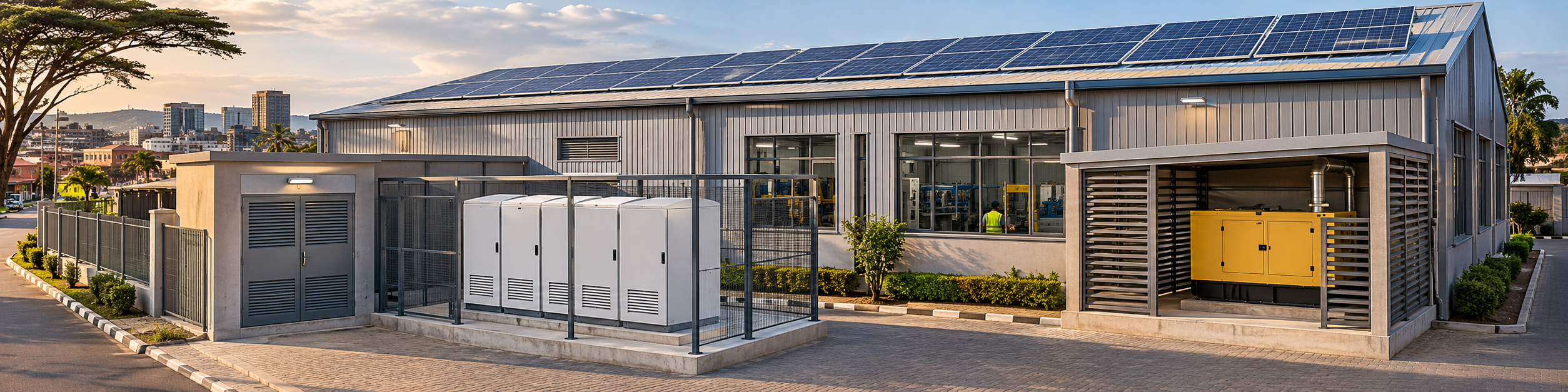
LFP chemistry does not determine the dispatch order. The proposal should explain how solar supply, battery charging and discharge, grid imports and diesel support are coordinated. A fixed solar-first, battery-second, diesel-last sequence is not a universal rule for every site. The priority must reflect the operating objective and the verified system design.
Reassess the Plan if an Outage Interrupts Tariff Operation
If an outage occurs while the battery is replacing expensive grid purchases, the objective changes to serving the agreed outage loads. Confirm which noncritical uses stop drawing on storage, what transfer interruption is acceptable and when diesel support may be required. Remaining battery energy alone does not establish island operation or seamless transfer capability.
A generator may support verified loads or recharge the battery, but its available supply must cover business demand and charging together. Diesel charging is not a free way to restore reserve; it affects fuel use, maintenance and the economic assessment. The BESS and diesel generators guide explains the power-sharing and recovery questions in more detail.
Confirm Recovery Before the Next Operating Cycle
A lower-price grid window helps only if supply is available and charging headroom exists. Restarting business loads, charge limits and the available time may prevent the planned recovery. Confirm the result from records rather than assuming the reserve is restored because a charging schedule ran. A larger battery does not fix a recurring energy shortfall by itself.
Use this operating worksheet for BESS for peak tariffs and backup review. It is not an automatic control sequence. Enter current evidence and unresolved conditions for each period rather than applying universal clock times, percentages or delays.
| Period or event | Storage and source role | Evidence to check |
| Before expensive hours | Solar or permitted grid charging | Actual reserve and concurrent loads |
| During expensive hours | Replace imports within reserve limits | Remaining energy and power limits |
| Unexpected outage | Critical-load priority and diesel support | Transfer capability and support duration |
| After supply returns | Restore operations and reserve | Charging headroom and recovery records |
Assess the Complete Cycle Rather Than the Tariff Gap Alone
The difference between high and low energy prices is not the project profit. Compare costs for the same service objective, including charging purchases or the opportunity cost of solar energy, conversion and auxiliary losses, diesel operation, maintenance and the effects of battery use. If most energy must remain reserved, the amount available for daily tariff shifting may be limited.
When evaluating BESS for peak tariffs, also compare backup-only operation, moving flexible business loads and deferring additional storage. Without account-specific tariffs, load records and outage information, a fixed savings percentage or payback claim would be premature.
Buyer Questions
Can Every Site Use the Same Reserve SOC?
No. The reserve needs to reflect critical-load duration, system deliverable energy and recharge conditions, with verification by the supplier or suitable professionals. This article recommends no universal setting.
Does Bill Reduction Require Removing the Generator?
No. Retaining a generator depends on the backup objective, equipment condition and energy supply during longer outages. Reducing routine grid purchases and retaining diesel support for outages can be separate tasks.
Key Takeaway
BESS for peak tariffs should not promise the same energy twice. Define the critical-load reserve, coordinate solar, grid and diesel roles, and verify recovery and cost over the complete cycle. Daily discharge is useful only when it fits the agreed continuity-of-supply objective.
When discussing battery energy storage systems with Solaura, provide the current tariff, time-based loads, critical-load backup target, solar and generator details, and outage records. Capabilities, control arrangements and service scope remain subject to the reviewed proposal and quotation.
Found this helpful? Share it with your network.
👇