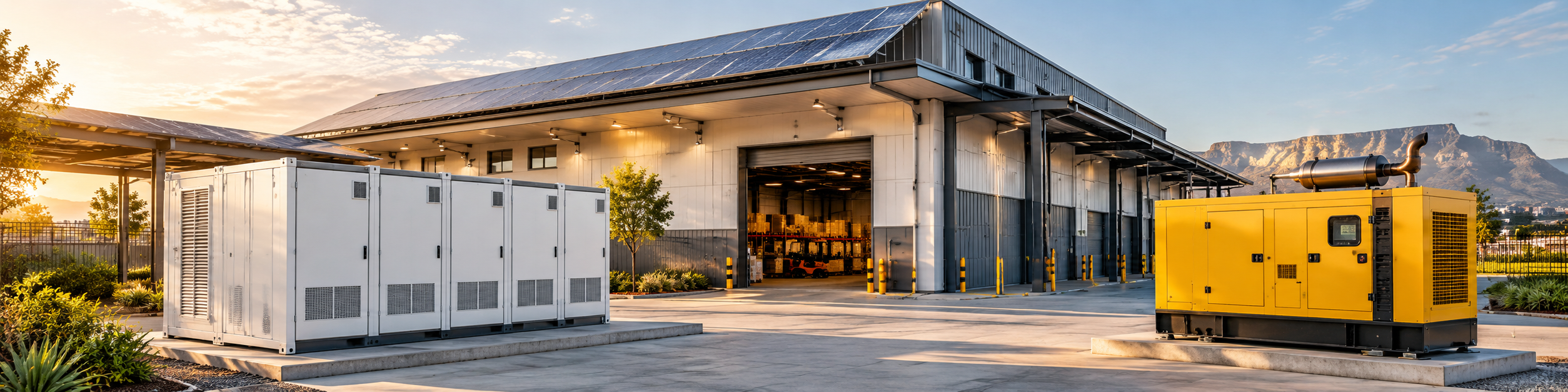
BESS vs diesel generator decisions start with outage duration and how the next supply of energy will arrive. A battery energy storage system delivers electricity stored earlier; a diesel generator produces electricity from fuel. A business may need either option or a coordinated combination, rather than an immediate replacement for its existing generator.
For factories, shops, farms and commercial facilities in Nigeria and other African markets, the comparison should follow the loads that actually need to stay on. These five checks help buyers decide which configurations deserve a quotation. They are not a substitute for a site design or a promise of a standard payback period.
Table of Contents
BESS vs Diesel Generator at a Glance
The table compares how the options supply power, without declaring an automatic winner. Battery storage needs suitable power conversion, protection and controls. A generator also needs appropriate switching, protection and site infrastructure.
| Check | Battery storage | Diesel generator |
| Energy source | Depends on prior charging | Depends on fuel supply |
| Runtime | Limited by usable energy and load | Limited by fuel, duty rating and servicing |
| Replenishment | Check charging source, power and time | Check fuel storage and deliveries |
| Site effects | No local combustion exhaust; fans may be audible | Noise and exhaust while running |
| Ongoing costs | Charging, losses, service and replacement | Fuel, servicing and overhauls |
Check 1: Match the Outage Pattern and Critical Loads
List the equipment that must stay on, its simultaneous demand, starting requirements and acceptable interruption time. A kW rating alone does not say how long a battery can run. A generator rating in kVA also needs to be checked against its power factor and rated operating conditions before it is treated as usable kW.
Separate frequent short interruptions from occasional extended outages. A battery that covers routine interruptions may not cover an entire night or several days. Medical, control or communications equipment may still need a dedicated UPS; a BESS should not automatically be treated as an uninterruptible supply.
A BESS vs diesel generator comparison should assign the same critical loads and service target to both options. When those loads are not yet defined, start with the business battery storage checklist.
Check 2: Check Runtime and the Next Charging Window
As a simple illustration, a constant 20 kW critical load operating for four hours needs 80 kWh delivered to the load. That is load-side energy, not a recommended battery nameplate capacity. Usable capacity limits, conversion losses, auxiliary consumption and the required reserve still need to be considered.
Even if capacity covers one outage, check whether the battery can recover before the next one. At 20 kW of net charging power, restoring 80 kWh takes four hours in an ideal calculation that ignores losses and charging limits; actual recovery may take longer. Net charging power is what remains available to the battery after other loads are served.
Daytime solar does not guarantee surplus electricity. Compare generation and load over the same intervals, including rainy periods and repeated outages. Use the BESS sizing guide for the sizing process rather than ordering equipment from this illustration.
Check 3: Compare Costs for the Same Backup Duty
Comparing BESS vs diesel generator costs requires more than a battery quotation and a generator price. Apply the same load, operating hours, reliability requirement and assessment period, then include installation, service, replacement and energy costs.
For diesel, use operating records or the manufacturer’s fuel curve at the relevant loads, rather than applying one full-load fuel figure to every hour. For storage, include charging costs and losses. Electricity used to charge from a generator is not free energy.
A useful starting point is diesel fuel cost equals hours at each operating condition multiplied by its litres per hour and the delivered fuel price. Battery charging cost equals charging input energy in each period multiplied by the applicable energy price. These are energy costs only, not the full cost of either project.
Sites with suitable off-peak tariffs, genuine solar surplus or substantial generator operation at light loads deserve further assessment. Savings still need to be demonstrated with site data. Without operating records, a fixed fuel-saving percentage or payback claim is not justified.
Check 4: Assess Hybrid Operation Before Full Replacement
In a suitable hybrid arrangement, the battery can serve selected periods, the generator can start when needed and potentially recharge it, and solar can contribute when available. These actions require compatible equipment and control logic; they do not follow simply from connecting the devices together.
Ask the supplier which device establishes the islanded grid, how generator start and stop are controlled, what happens at low battery charge, and how loads are protected after a communication failure. The U.S. Department of Energy introduction to distributed energy resources and microgrids provides system background, not a project-specific design or approval.
The 2017 study Increasing Resiliency Through Renewable Energy Microgrids evaluated solar and batteries alongside existing diesel generators at a U.S. telecommunications facility. It supports assessing hybrid configurations, but its site-specific costs and resilience results should not be transferred directly to African projects.
Check 5: Confirm Site Conditions and Service Responsibility
A battery does not burn diesel at the point of use, but it still needs temperature management, protection, service access and applicable fire-safety measures. A generator needs exhaust arrangements, noise management, fuel provision and maintenance access. Neither option should be described as risk-free or maintenance-free.
Require the quotation to identify responsibility for site works, integration, commissioning tests, training, warranty boundaries and local response. For a site with an existing generator, provide its model, control interfaces and maintenance history. Confirm compatibility before deciding whether to retain, modify or replace it.
FAQs
Is Battery Storage Always Cheaper Than Diesel Backup?
No. BESS vs diesel generator economics depend on usage, charging sources, fuel consumption, electricity prices, installation scope and replacement schedules. Equipment that rarely runs can produce a very different result from equipment used for several hours each day.
Can an Existing Diesel Generator Work With a BESS?
Possibly, but rated conditions, control interfaces, charging limits, protection and transfer arrangements must be checked. The supplier should identify supported configurations and testing scope. Matching voltage alone does not establish compatibility.
When Might a Business Retain Its Generator?
Retaining a generator deserves consideration when extended outages may exceed usable battery capacity, charging opportunities are uncertain, or the project requires another energy source. The decision should follow the service target and site design, not battery capacity alone.
Request a Backup Power Review
Submit the location, critical loads, outage records, existing generator model and fuel use, solar generation, charging conditions, installation space and target schedule. Organizing these details with the BESS procurement documents guide helps suppliers compare battery, diesel and hybrid options against the same backup target.
Project details can be submitted to Solaura for an initial supply-scope review. Final configuration, pricing and performance commitments should be based on verified site data and agreed acceptance conditions.
Found this helpful? Share it with your network.
👇