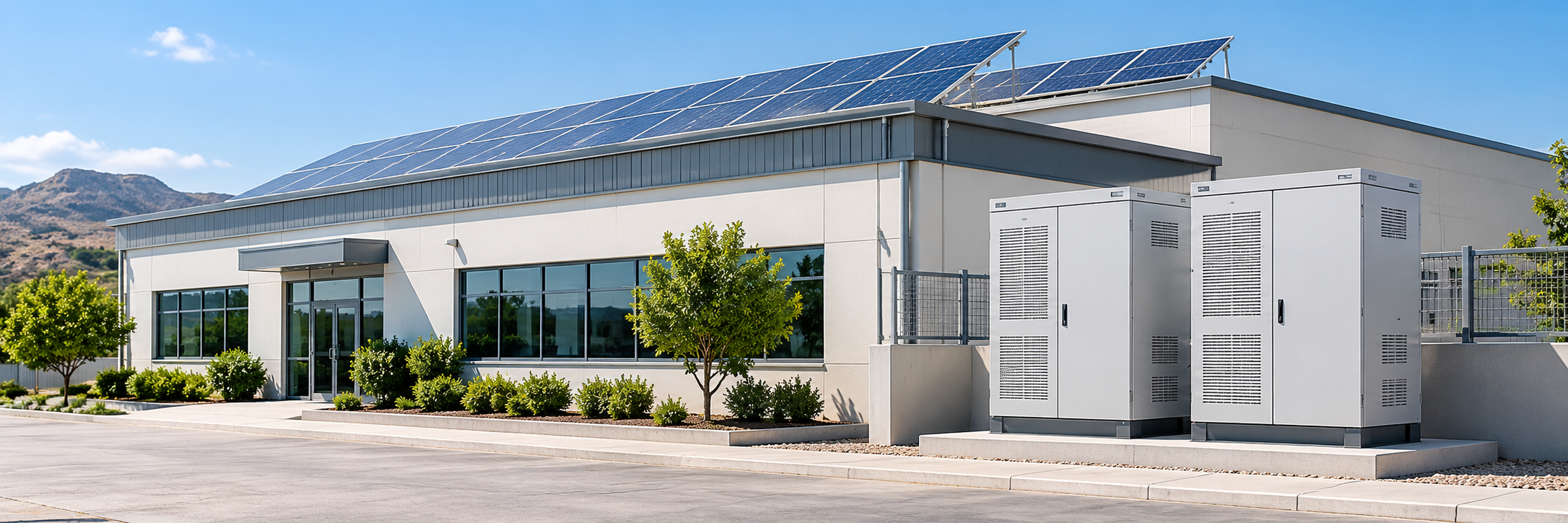
Off-grid battery storage must do more than cover one night. It also needs a realistic way to recover enough energy before the next operating cycle. Commercial buyers should review demand and charging opportunities across consecutive days before choosing capacity. If the energy supply remains below demand, a larger battery only delays the shortfall; it does not remove it.
This guide follows an illustrative commercial site through its operating cycle. It explains how to separate energy from power, build an energy balance and define what happens when charging falls short. The figures explain a method; they are not project results or equipment recommendations.
Table of Contents
Define What Off-Grid Operation Must Support
A site without a utility connection has a different service requirement from a grid-connected site operating independently during an outage. The first cannot rely on the grid returning to recharge the battery. The second should not assume restoration will happen on schedule. Record the available energy sources and the operations that must continue.
Separate essential demand, such as refrigeration or communications, from work that can move to another time. Record the acceptable interruption for each load. Off-grid capability does not automatically mean uninterrupted power. For sensitive equipment, the designer should confirm supply continuity and transfer arrangements rather than relying on a backup label.
Off-Grid Battery Storage Through the Next Day
When assessing off-grid battery storage, examine the energy left after overnight use and the amount that can actually be restored after daytime loads are served. Total solar generation is not all available for charging. The timing of demand and generation, charging limits and losses all affect the result.
An Illustrative Three-Day Energy Balance
The simplified example starts with 120 kWh of available stored energy, excluding an unavailable protective reserve. All figures use one consistent storage-energy accounting boundary: charging is the net addition after losses, and withdrawal includes the stored energy consumed to serve the loads. Charging is assumed to occur before withdrawal each day, without reaching the upper capacity limit. A real project needs a finer time-step simulation.
| Day | Opening kWh | Net charge kWh | Planned withdrawal kWh | Closing kWh | Unmet kWh |
| 1 | 120 | 30 | 80 | 70 | 0 |
| 2 | 70 | 40 | 80 | 30 | 0 |
| 3 | 30 | 20 | 80 | 0 | 30 |
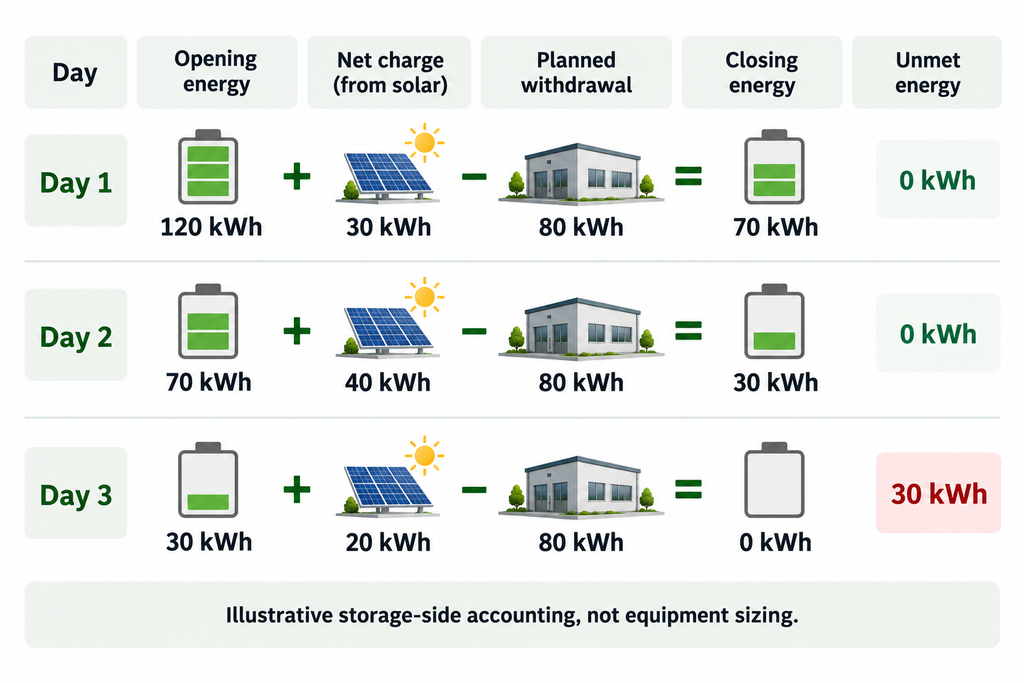
Completing day one does not mean the original schedule can continue through day three. On day three, available energy covers only part of the planned withdrawal. The remaining 30 kWh must come from an approved alternative supply or be avoided by rescheduling flexible demand. The result is not a negative battery balance, and it is not permission to discharge below the manufacturer-approved limit.
This example does not recommend a 120 kWh battery. It does not model power limits or equipment dynamics, and it does not represent measured weather. It shows why off-grid battery storage needs an energy-recovery plan rather than a capacity number alone when consecutive days have a net deficit.
Check Power and Charging Time Separately
Enough daily energy does not establish that a system can start every machine. Check maximum simultaneous demand, motor starting requirements, PCS or inverter capability and battery current limits separately. The BESS sizing guide covers the initial capacity assessment; this article focuses on whether subsequent operating cycles can be sustained.
For example, restoring a net 60 kWh in a genuinely available three-hour window requires an average net charging rate of at least 20 kW. That is an arithmetic minimum, not a charger recommendation; it does not model charging restrictions at different states of charge. The upstream supply must also cover simultaneous operating loads and the relevant losses.
Agree on the Response Before Energy Runs Short
A commercial site should define which flexible tasks pause first, who is responsible for backup supply and what happens if that supply fails to start. These are design and operating decisions, not instructions for staff to change protection settings during a shortage.
The Victron generator control manual illustrates condition-based control, including battery state of charge and load, within supported systems and interfaces. It is an example of why control conditions must be specified, not a claim that Solaura equipment provides the same functions or supports those controllers.
If a generator remains part of the plan, confirm fuel availability, maintenance and on-site starting support rather than checking rated power alone. The BESS and diesel generator comparison discusses the choice of supply arrangements. Here, the task is to document how the selected arrangement restores energy during off-grid operation.
Make the Quotation Reflect Repeated Operation
Ask the supplier to explain operating assumptions using hourly or finer demand and generation data. Record the starting state of charge, reserve, charging limits and any unmet demand. Similar average daily generation and consumption are not a substitute for analysing consecutive days.
The quotation should identify site data that have not been measured, who will review them, whether further simulation is required and the equipment and site-service scope. Use the BESS procurement documents guide to organise the enquiry. Do not promise year-round independence, fixed fuel savings or a payback period before these conditions are established.
Buyer Questions
Can a Larger Battery Solve Several Cloudy Days?
It may extend operation, but it does not automatically solve a continuing energy deficit. Review low-generation periods, demand adjustments, alternative supply and the ability to recharge together.
Does Every Off-Grid Project Need a Generator?
Not necessarily. The decision depends on the reliability target, local energy resources, demand and acceptable downtime. A generator is not presented here as a mandatory component for every project.
Key Takeaway
Off-grid battery storage should be purchased around a repeatable operating cycle: every withdrawal needs a realistic recovery path. Check consecutive energy balances, then confirm power, charging time and the response to shortfalls. That produces a more actionable project brief than comparing battery kWh alone.
For a Solaura review, provide the location, load records, existing solar and generator details, low-generation periods and acceptable downtime. Configuration and service availability remain subject to the verified project scope and quotation.
Found this helpful? Share it with your network.
👇