BESS and diesel generators need a repeatable operating plan, not just a connection between two pieces of equipment. Define which loads the battery will serve, when the generator takes over and how much power remains for charging. Without those answers, adding storage may change the timing of supply without reducing total cost.
This guide follows an operating cycle from a quieter period through generator operation and battery recovery. The tables are simplified assumptions, not measurements from a Solaura project. They are not wiring instructions, protection settings or equipment control parameters.
Table of Contents
Start With the Job Storage Must Do
A commercial site in Nigeria or another African market may already use diesel generation during outages. Storage might cover short supply gaps or allow the generator to remain off during selected periods. The objective needs operating records, not just a generator rating or a battery price.
The BESS vs diesel generator guide helps compare supply options. This article focuses on a site that plans to retain its generator and needs to understand how a complete operating cycle would work.
During a Quieter Period the Battery Has a Defined Job
For BESS and diesel generators, first identify the loads that must remain supplied while the engine is off. If business loads stay at 20 kW for two hours, they need 40 kWh at the load boundary. That does not mean a 40 kWh battery is sufficient: usable capacity, conversion losses, auxiliaries and reserve still matter.
The installation must support independent supply and the required load starts and transfers. If it cannot operate that way, a low average load does not prove the generator can stop. Seamless transfer and motor-starting capability are not default features of every storage cabinet.
When Demand Changes the Generator Needs a Clear Role
Generator operation may be needed when battery reserve is low, demand exceeds confirmed battery supply capability or the operating plan requires recharging. The project design must establish which conditions apply. Do not copy an online state-of-charge percentage into equipment settings.
The Victron generator start and stop manual describes triggers based on battery state of charge, load and other conditions, with runtime, warm-up and cool-down options. These are features of that manufacturer’s system, not proof that a quoted Solaura system is compatible with an existing generator.
Distinguish transferring between sources from having both sources support a load at the same time. An automatic start signal does not establish parallel-operation capability. State the acceptable interruption time and request checks of phase arrangement, interfaces, protection and supported operating modes.
BESS and Diesel Generators Must Share Available Power
Suppose a generator has been assessed as able to provide 80 kW continuously under the relevant site conditions and duty. Business loads are steady at 50 kW. Assume no grid or solar contribution and no battery power assistance. Ignoring auxiliaries and distribution losses, at most 30 kW remains at the charger AC input.
| Item | Assumed value |
| Assessed continuous generator power | 80 kW |
| Business loads | 50 kW |
| Theoretical charger input headroom | 30 kW |
| AC charging input over one hour | 30 kWh |
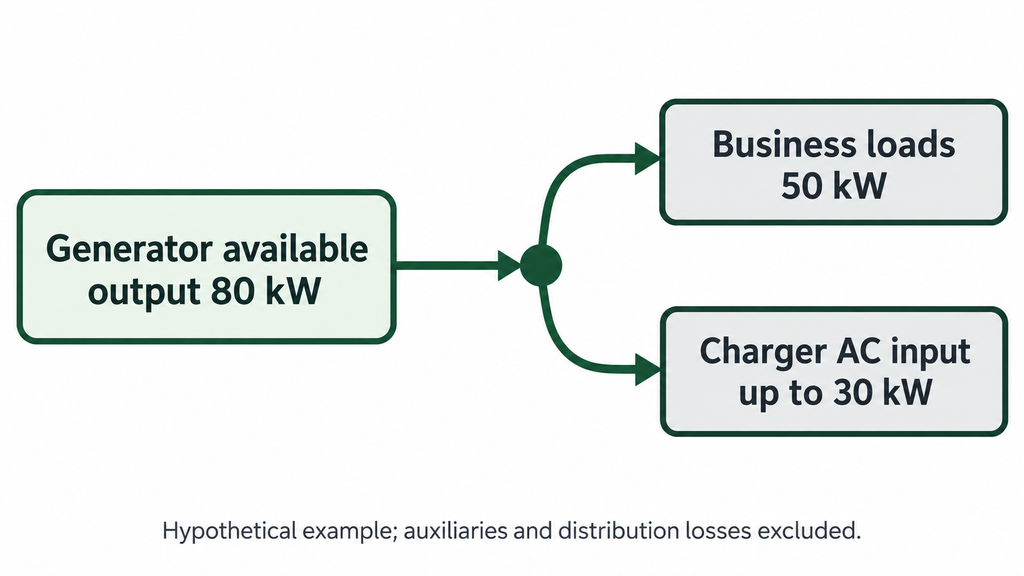
If loads rise to 70 kW, theoretical charging headroom falls to 10 kW at the same boundary. A 40 kW charger rating does not create additional supply. The actual design also needs generator kVA and current limits, phase loading, transients and battery charging limits. This subtraction is not an engineering approval.
The Victron generator FAQ explains that charging demand can overload a generator and discusses input limits. It illustrates why loads and charging must be assessed together; its model-specific values and configuration steps should not be applied to other products.
A Running Engine Does Not Mean the Battery Has Recovered
If the 30 kW AC charging input above is sustained for one hour, 30 kWh enters the charger. It cannot all be counted as energy available to loads later. It is already below the earlier 40 kWh load requirement, before losses are considered.
This simplified cycle cannot repeat without additional energy. For BESS and diesel generators, a larger battery may delay depletion, but it cannot fix an energy deficit in every cycle. Longer charging, another confirmed charging source or a different load schedule requires a revised calculation.
Dividing 40 by 30 gives about 1.33 hours, but that is only an ideal energy lower bound with losses, auxiliaries and changing power ignored. It is not an actual recharge time. The BESS sizing guide separates power from energy; operating duration still needs equipment-specific verification.
Use Operating Records to Test the Investment
Fewer engine hours do not imply the same percentage reduction in diesel use. Recharging may increase generator loading during the remaining hours. Assess BESS and diesel generators across a complete cycle with comparable service requirements, including the cost of any other charging source.
| Record | Purpose |
| Time-stamped business loads | Compare equivalent service requirements |
| Generator output and runtime | Identify the actual operating duty |
| Fuel consumed in the same interval | Avoid treating runtime as fuel consumption |
| Charging input and load-side output | Check boundaries and energy balance |
| Stored-energy trend and fault records | Review recovery and interruptions |
Records should cover busy and quiet periods, not only the best day. Match generator fuel records, loads and charging measurements to the same interval. Battery losses, maintenance, capital cost and unserved-load risk also affect the investment. This article does not establish a project payback period.
Buyer Questions
Can the Existing Generator Always Be Retained
Not necessarily. Check its model, duty rating, output quality, control interface and condition. Producing electricity is not the same as supporting the intended operating plan. Equally, adding storage is not a reason to discard usable equipment without evidence.
Is Battery Capacity Enough to Decide When the Engine Runs
No. Capacity alone does not describe available energy, changing demand or the recharge window. Before purchase, review the control plan and intended response to lost communication or a failed start. A general article cannot supply universal thresholds.
Key Takeaway
BESS and diesel generators need a verified cycle of supply, charging and recovery. Confirm supported modes and site headroom before comparing equipment and total cost. A larger battery or fewer generator hours alone does not prove a more economical or reliable solution.
When discussing battery energy storage systems with Solaura, provide the location, load records, generator nameplate and controller details, outage periods and acceptable transfer interruption. Configuration and service scope remain subject to the verified project proposal and quotation.
Found this helpful? Share it with your network.
👇